



[Part One, Shinto Christianity, by Brian Scarffe, can be found here.
Part Two, Shinto and the Saints, also by Carlos Perona, can be found here]
By Carlos Perona (Europos)
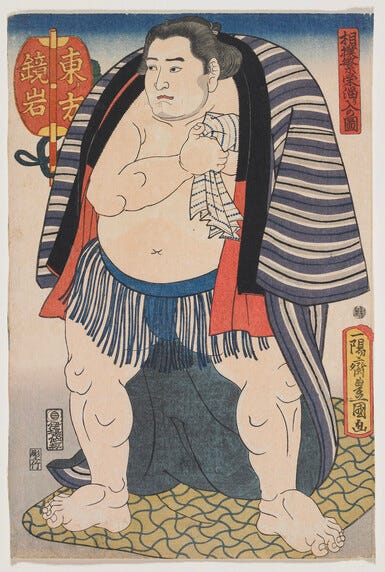
Drums are pounded.
Raised clay is matted down by the easy yoke of reverence.
Priests recite names of them whose ethereal presence they would render palpable to the hushed assembly. Invisibly, kami join the human crowd.
Salt is swung on purified soil.
Wrestlers bow.
Perhaps one of the few yet-to-be disenchanted examples of sacred combat, at least in the developed world, is Japanese Sumo.
Heaven’s War
As with the sky and earth deities that founded the sport, their latter-day human avatars balance opposing forces: power and prowess in a frame at once capable of explosive forward advance and the agility of judo-like reversals.
It was the clash of Takemikazuchi and Takeminakata that inaugurated Sumo. A thunder-wielding being born from the blood of a rebellious fire demon brought low by Heaven, and an earthly warrior presiding over agriculture, water, wind, respectively. Takemikazuchi was born after the war between Olympians and Titans, as Greek tradition remembers it. The great carnage that preceded the human age in which Æsir faced off against giants in Norse accounts, devas against asuras, in which Lucifer was cast down.
Following the inevitable angelic victory, however, the infant earth was in a state of chaos. The celestials had to subdue the Ashihara no Nakatsukuni, Midgard, “Middle Earth.” Order had to be established, to which end Takemikazuchi was deployed.
But this conquest was not to be unilateral. The lower portion was out of sync with the higher, in need of subduing—but would be glorified thereby.
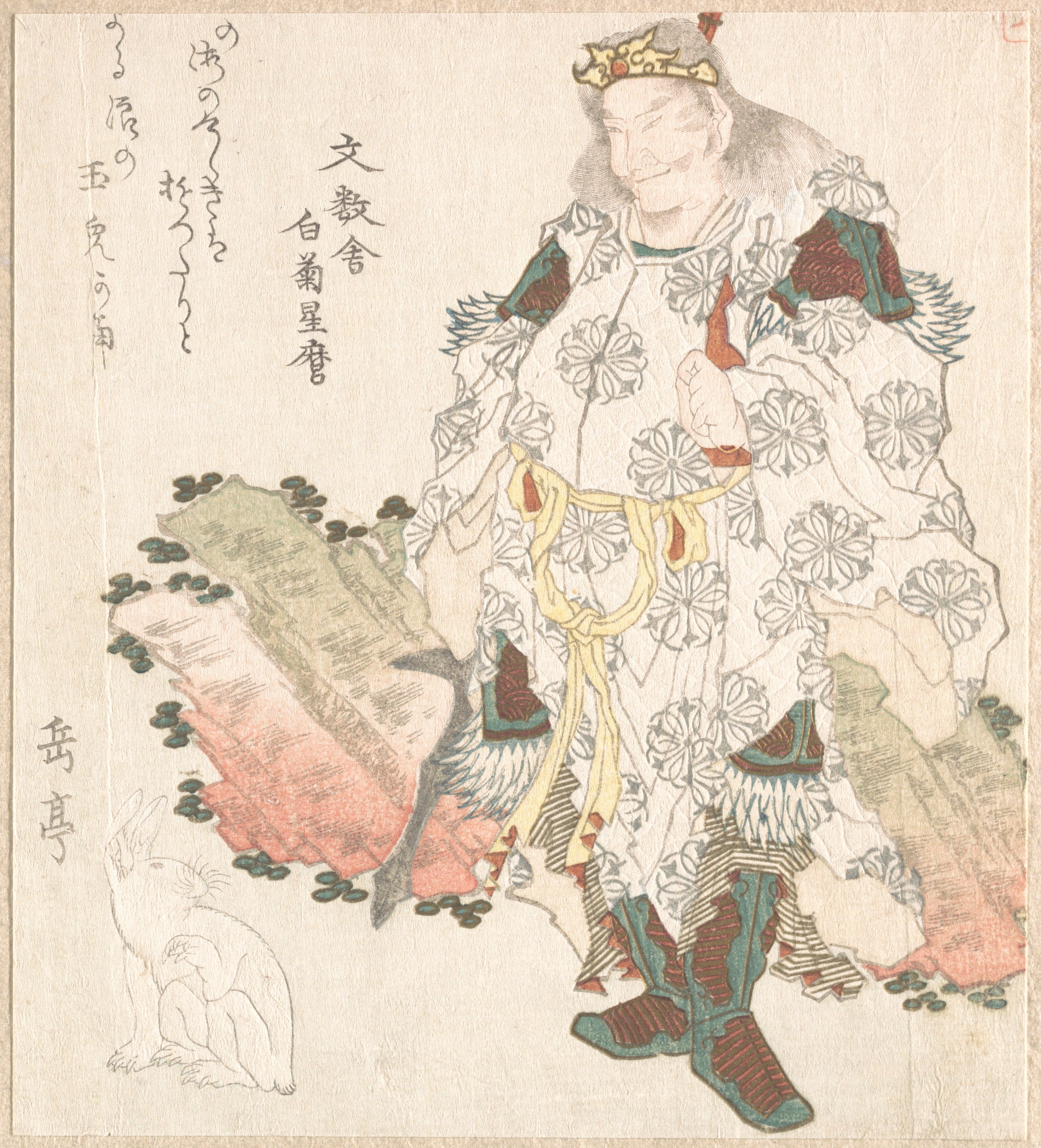
Takemikazuchi descended and went forth to the telluric deity Ōkuninushi, asking that he relinquish the realm. Everything was now to be brought into alignment with heaven. But of Ōkuninushi’s children, one refused. Takeminakata would not see his race of nature-spirits deposed. Therefore did the two face off, and although Takeminakata was ultimately defeated, he was awarded a position of honour all the same. The similarity of their names suggests they represent corresponding principles, two forms of one principle.
Takemikazuchi then went on to aid Emperor Jimmu—the foundational ancient emperor of the Japanese people—in his conquests, helping establish a politically pacified human dominion: the defeat of rebellious spirits and the pacification of the Earth makes room for the vice-regent of Heaven on Earth, human centre of creation.
Each Sumo wrestler is both Takemikazuchi and Takeminakata. When an athlete competes, he struggles against himself, ordering inner impulses unto outward ordeal. The desire to veer from diet and routine, lethargy to skip an exercise, compulsion to overtrain, nervousness on the day—these are the rebellious earthly Takeminakata.
But in defeat, he is a prince.
The body acquires the habits we inculcate. Eventually, it drills the movements we’ve taught it as a second nature.
This idea is widespread. In the Kerala region of India, for example, the ritual fighting style of Kalaripayattu is said to originate from Parashurama, the sixth avatar of the god Vishnu, reclaiming land from the sea on which Kerala was established. He then taught this martial art to its inhabitants that they might protect their country. As in the Japanese case, combat is a reclaiming and ordering of nature.
In Sumo, this is present from the outset. Consider how a match begins: both wrestlers place their hands on the ground. Although they want to start from a position of stability and readiness, knowing that as soon as their opponent is likewise positioned they will get only a fraction of a second to react, they must calm their impulses long enough to coordinate with the man in front of them.
Our Patron, Heracles
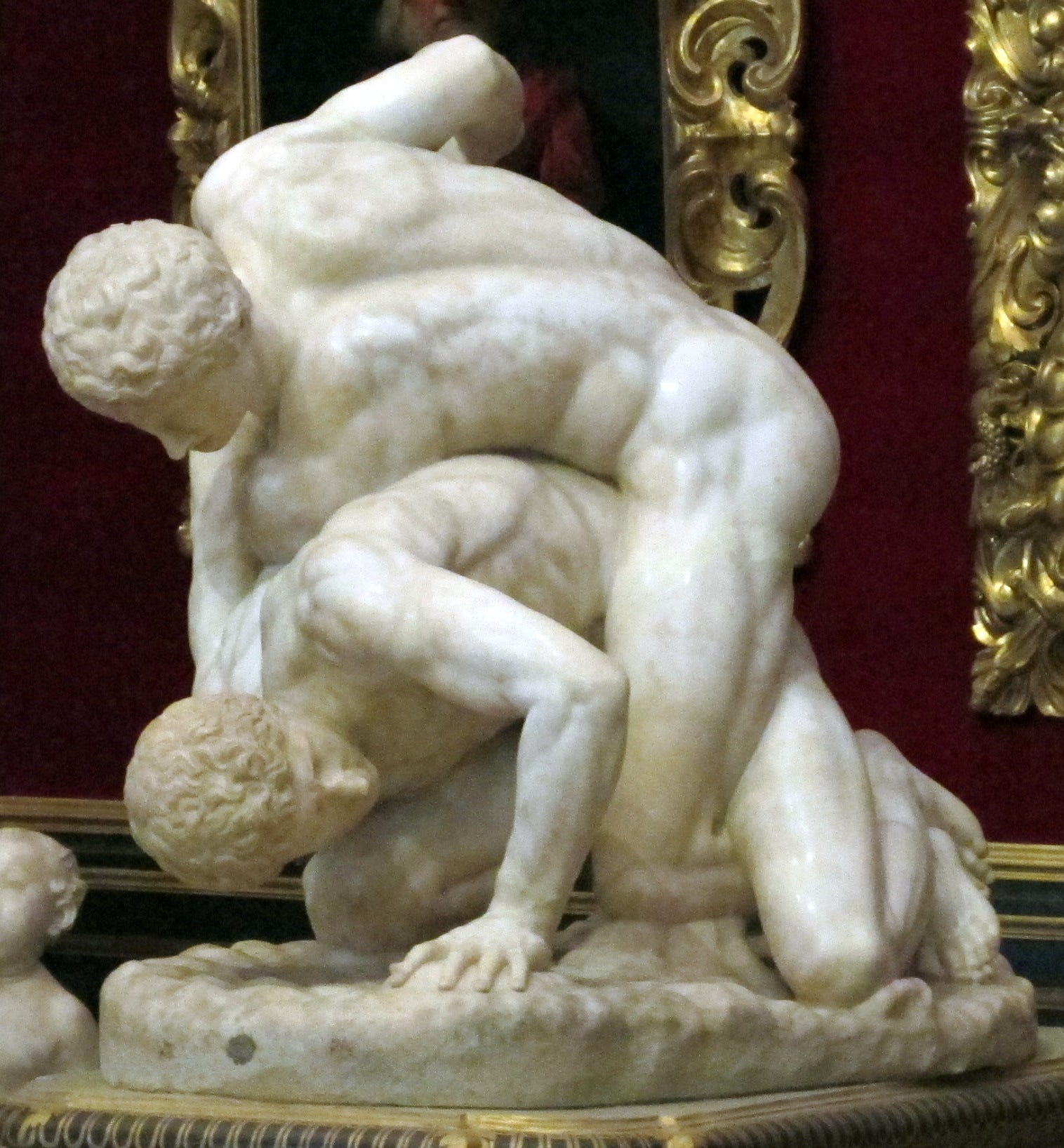
In Europe, Greco-Roman wrestling and Pankration have both been attributed to Heracles and Theseus, being the set of techniques that, according to various accounts, were used by them during their respective quests.
In particular, they originate from the defeat of Antaeus, son of Gaia, by Heracles. One is heavenly, a champion of Olympus; the other an earthly fighter, disordered nature, an oppressive giant who has to be put in his place.
We should also remember Theseus’ facing-off against the Minotaur as a mythic example of Pankration. And, of course, Zeus defeating Typhon, in a sense integrating the serpent-dragon into the natural order, and Apollo doing the same to Python, are more remote examples of the same principle.
Focusing on Antaeus, however, it is said that he was the son of Poseidon and Gaia, the ocean and earth as disordered, inhospitable nature, and that he was a tyrant who would challenge whoever travelled through his North African realm. Once he defeated them in a wrestling match he would murder the unfortunate wayfarer and use his bones to build up a macabre temple to his father, a demonic Poseidon, tribute to the waters of chaos. But his stronger connection was to his mother Gaia, for whenever he would touch the ground he would draw up power from her and for this reason could not be bested. Even if an opponent succeeded in throwing him down, this would only revitalise him thereby.
We read about Antaeus and his contest with Heracles in the work of Diodorus and Apollodorus, for example. One reading of this myth suggests that language about his mother being the Earth—such that he could draw up power from being on the ground—is describing the technique of a grappler specialising in groundwork. For one unskilled in this, such a wrestler would indeed seem to counterintuitively gain strength from being cast down.
Philostratus in Imagines (II) describes this:
Antaeus, whom the Earth bore to do mischief to strangers by practicing, I fancy, a practical style of wrestling.
When Heracles faced Antaeus, then, he had to figure out how to keep a lock on the grappler while lifting him so that the son of Gaia would not come into contact with the ground. Facing the tyrant’s unique technique, the hero had to improvise, inventing a new fighting style.
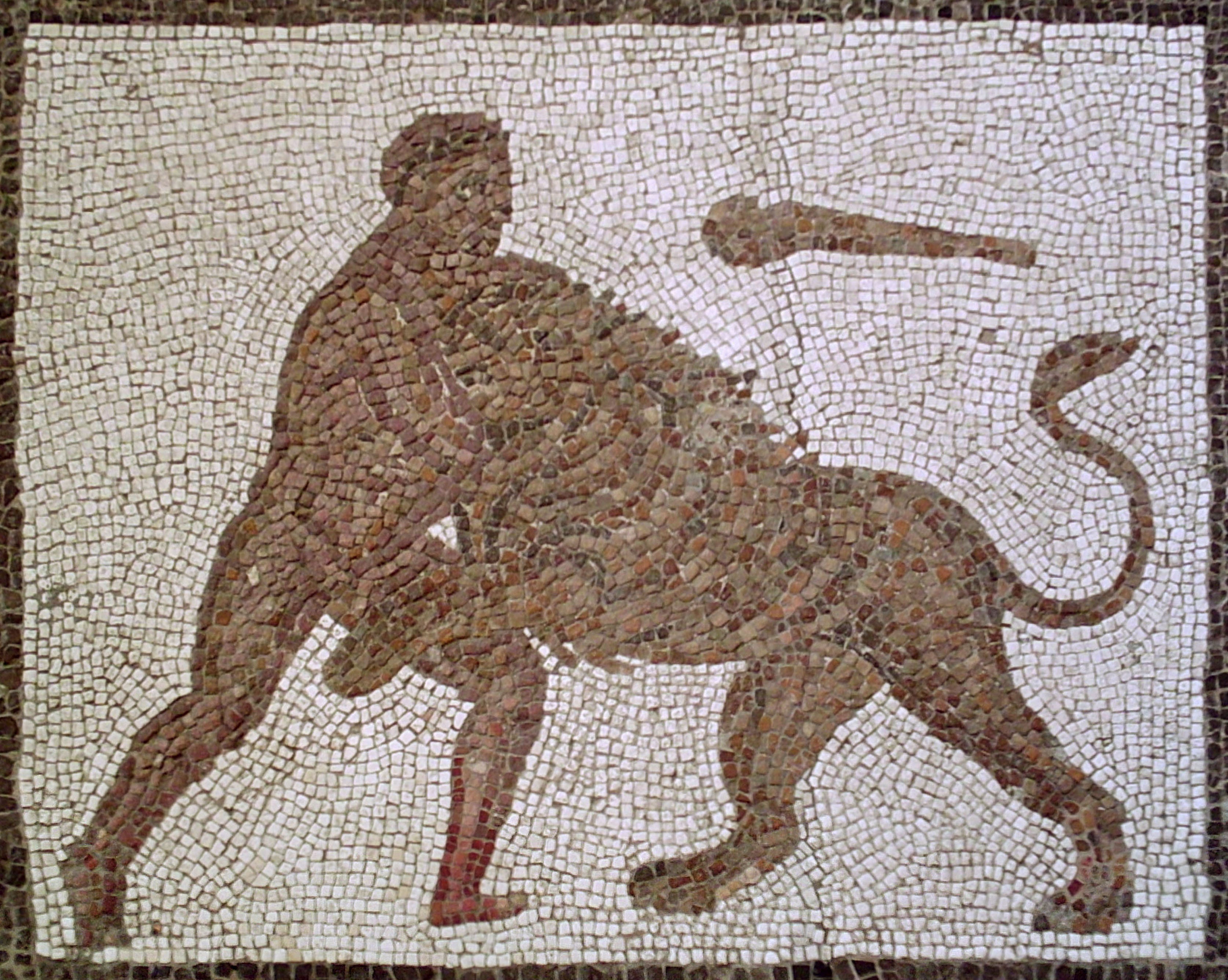
Pankration also involves striking, but this event may be the mythic origin of grappling. Heracles could already wrestle, as we read concerning his defeat of the Nemean lion, to which he applied a rear naked choke after clobbering it with his club and so disorienting the beast. This is discussed by Theocritus in his Idylls.
With Antaeus, however, he had to rely on grappling alone, and it was grappling of another order. He could not pin his opponent to the ground, not could he knock the giant down as with the lion, or rely on striking without risking causing Antaeus to regain his strength after getting knocked to the ground.
The Gaia connection is interesting because grappling is, in a sense, the yin or feminine component of fighting compared to striking, the yang or masculine component. At least this is one possible conceptualisation. In The Tao of War by Mikel Abdul Latif we read:
The yin of the grappler envelops the one, becomes many, as the one grappler becomes many limbs. The yang of the striker penetrates: the many becomes one, as the many limbs of the striker gather into a single fist.
Antaeus’s earthly maternal Gaia-given grounded grappling is the use of nearness, envelopment, femininity for the sake not of honourable combat, but combat forced upon travellers, a ruthless violation of hospitality, and not ending in honourable defeat but in murder. It is an image of corrupted nature, corrupted femininity, and, that half-imagined matriarchal human-sacrificing period in the remote past which Heracles is credited with putting an end to. Robert Graves speculates as much in the context of other myths around Hercules. Of course, Antaeus sacrifices to Poseidon, the male as raging ocean—corrupted masculinity. Wherever we encounter the corrupted feminine we have the corrupted masculine as well. Babylon and Beast.
Being a giant, Antaeus symbolises old forces improperly manifesting in human form—big, tyrannical ideas, hypertrophic distortions of the human scale: the Nephilim giants of the Bible and an echo of the more remote Titanic rebellion. Heracles, correspondingly, is a David figure.
It is significant that the defeat of Antaeus comes before Heracles goes on to secure the apples of the Hesperides, the fruit of immortality, and so seems to mark the final perfecting of his ability as a martial artist. By this point in his journey Heracles has acquired all the necessary techniques to pacify the earth, corresponding to the pacification of the inner nature. After this, he will deal with one more giant, Geryon, and then the dragon Ladon.
The hero’s wrestling style, which must now incorporate and perfect grappling in order to defeat and balance yin and yang—feminine grappling and masculine striking, nearness and distance—is the ordering of nature, putting her in proper relation to humanity: no longer as source of vicious murderous strength.
It isn’t the defeat of Gaia but of Gaia’s evil son. It’s not yang against yin, striking against grappling, but the harmonising, the complementarity, of these. Our nature is properly aligned, like the serpent on Moses’ staff or the straightening of the dragon Typhon after its defeat by Zeus that it may provide heat to the holy volcanoes of Etna and Cumae, Sicily and Naples.
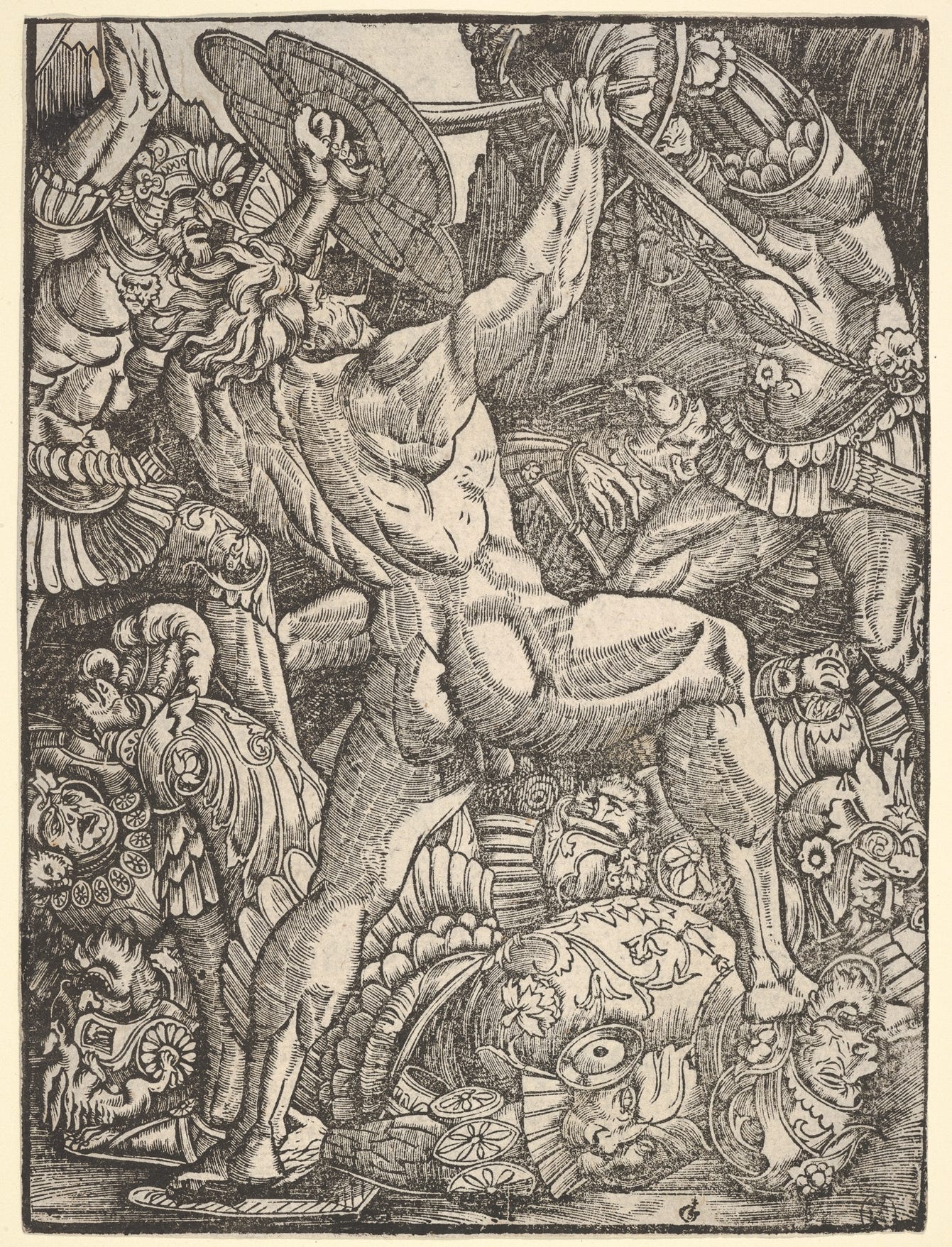
The defeat of Antaeus is also similar to the myth according to which Heracles had to hold Proteus, the shape-shifting god, in place with a firm grip despite the many forms that this god took. Through his many transformations Hercules had to keep him fixed. Through the many oscillations of the mind, the spiritual hero must keep his attention, his focus.
Forward
Europe and the West are in need of a renewed folklore, I would argue—a connection with the past, especially when it comes to taming lower nature, the instincts.
Mechanically, technically, any modern combat sport would have to be a species of mixed martial arts. But the specific rules and overarching ritualism can be made reverential. This could include pageantry and an element of theatre expressive of the founding myth—like a spiritually elevated wrestling entertainment. A Western MMA turned sacred combat, where Heracles and Antaeus (or Heracles and Proteus, and Theseus and the Minotaur, Apollo and Python, Zeus and Typhon) are its patrons, should be part of the work to renew and reinvent ourselves.
St. George and the Dragon is another and perhaps most accessible iteration of this symbolism. We need to be hailing St. George.
👏👏