


[Carlos Perona’s original text for Soothsayer, “Sex in Heaven”, to which the below is a response, can be found here]

Alongside Christianity, which takes its wisdom from Egypt via the patriarch Joseph and the prophet Moses, Plato stands as the great bridge for Egyptian wisdom to flow into Europe. An initiate of the mystery schools, Plato‘s work uses esoteric allegories to offer a pathway for the seeker to begin his own initiation, the process of death and rebirth. Those who search well may find Wisdom herself guides his journey of return to the One. One such allegory is that of the primordial hermaphrodite found in the Symposium in which he explains that the current state of Man, divided into male and female, is the result of a punishment from Zeus:
Now, since their natural form had been cut in two, each one longed for its own other half, and so they would throw their arms about each other, weaving themselves together, wanting to grow together.
Eros therefore is the desire to overcome this wound in our nature, the drive to find the part which is missing from ourselves:
Each of us, then, is a “matching half” of a human whole, because each was sliced like a flatfish, two out of one, and each of us is always seeking the half that matches him.1
This mystery tale resonates with our other great myth of Man divided in two, Genesis. There we are told that in the beginning God created Man as a single unified being, but Eve comes onto the scene as a result of being taken from Adam’s body:
Then the Lord God cast a deep sleep upon Adam: and when he was fast asleep, he took one of his ribs, and filled up flesh for it. And the Lord God built the rib which he took from Adam into a woman: and brought her to Adam. And Adam said: This now is bone of my bones, and flesh of my flesh; she shall be called woman, because she was taken out of man.2
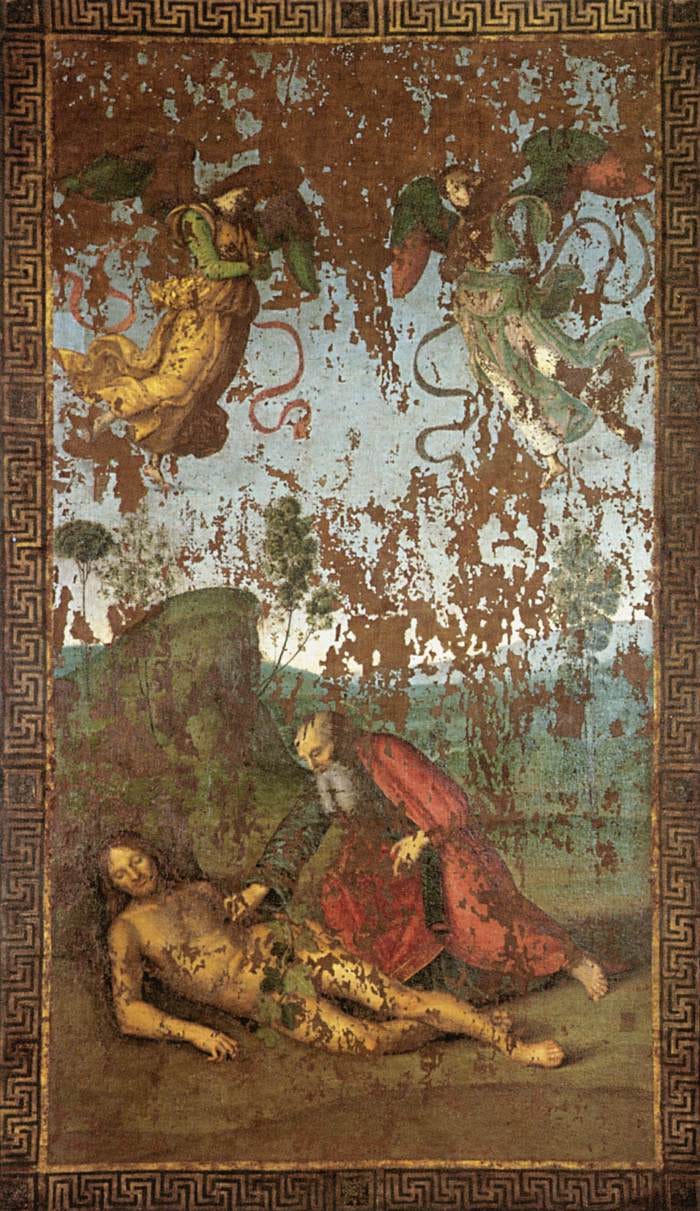
Nothing new is found in Eve that was not once in Adam for she is his rib, but in the separation all that is in Eve is removed from Adam. Rather than the simple interpretation that this is an addition to the life of Adam, what we have in the text is the story of loss, Adam is alienated from a part of himself. Therefore, just as in Plato’s allegory, Man must now find himself a wife and cleave to her, to become “one flesh,” the process to restore his broken self. When we read that Adam “knew” Eve, the biblical phrase indicating sexual union, he was only coming to know his lost self, he was—however fleetingly—becoming whole.
The desire which drives us on this fallen earthly plane is that flowing from incompleteness. But it must not be understood as merely a human crisis this loss of unity; it is a fundamental rupture of Heaven and Earth. In traditional systems of symbolic interpretation of the cosmic language, man and woman are living hieroglyphs of the two great principles of duality: active form and passive matter. From the mythological binary of the Sky Father and Earth Mother, the male Sun and the female Moon, to the technical causal relationships between Morphe and Hyle this duality is a semiotic reality in our world but its ultimate expression is that of the transcendent and imminent relation: Heaven and Earth.
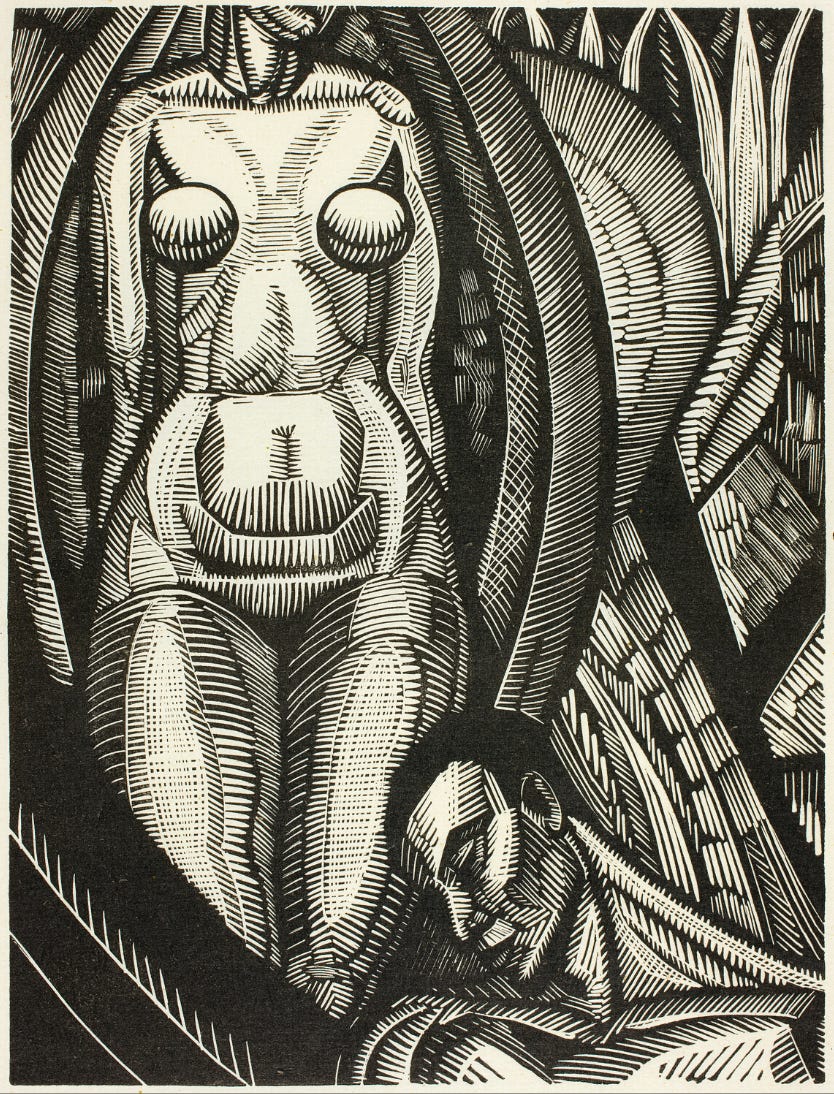
For this reason we find in the Christian scriptures the central relational motif between Creator and creation to be that of bridal mysticism. Throughout the Old Testament God is portrayed as a lover and Israel as his beloved (who cannot remain faithful). The highest expression of this is the “Song of Solomon” in which erotic imagery presides explicitly over the relations between humanity and the Divine. But this imagery is always one of incompleteness, pursuit but not final consummation, a union foreseen but as yet unfound. This is mirrored in human relations, the act of union between a man and a woman is always only partial, fleeting at best. The Church has herself become bogged down in the question of whether sex is about procreation and to which degree pleasure should be allowed a teleological position but has barely begun to properly contemplate the nature of erotic union both for man and woman (the Hindu, Taoist and Tantric traditions have a richer tradition here) and the union of Heaven and Earth of which it speaks. Perhaps it is the very nature of the subject matter that it struggles to be captured by the pen with only the ecstasies of the mystics treading these lofty pathways.
A closer examination of human psychology is necessary to understand what was lost in this separation of Man from his own self as Eve was taken from his side. The binary of which we have already written of; the masculine and feminine principles finds its own analogy within the occult anatomy of Man. Part of the deposit of ancient wisdom which was central to understanding man’s own ability to know was that his reasoning faculties were two: Ratio and Intellectus. Centred in the head and heart respectively Ratio was the masculine working element which performed discursive reasoning and Intellectus was the passive feminine element which, like a mirror, was capable of receiving direct Divine illumination. Both are necessary for the proper functioning of the knowledge economy but each faculty finds a stronger instantiation in one of the biological sexes: Ratio in Man and Intellectus in Woman.
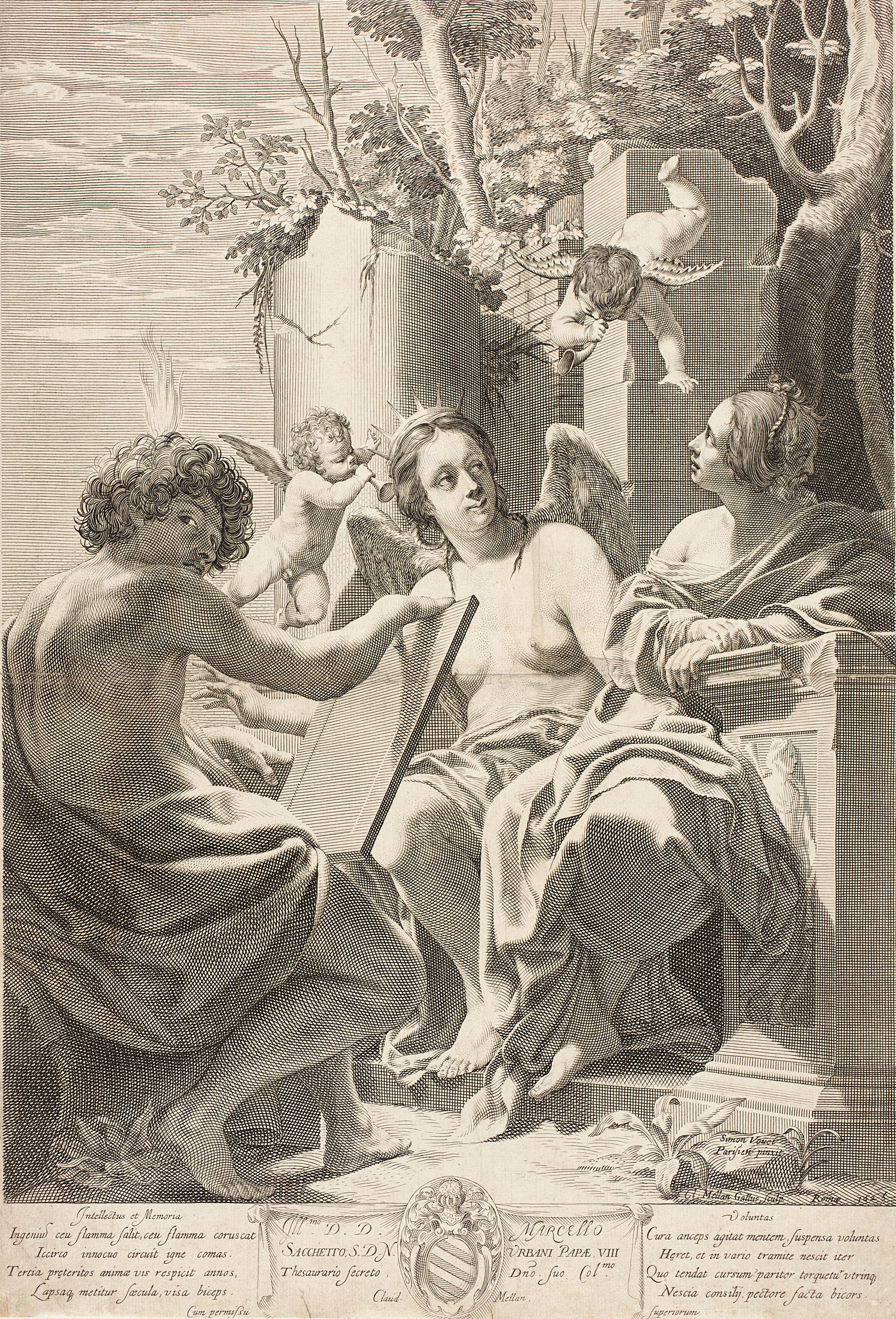
Each sex in turn suffers a weakness in the faculty for which its opposite is known, men lack the intuition which comes with the passive receptivity of the mirror of the heart and women lack the hard logical reasoning that the head offers. In traditional psychology it is understood that the passive gnosis of the heart is the higher of the two faculties and the active knowledge the lower. The very biological differences of male and female themselves should be understood as expressions of these principles. Man is the biological manifestation of Ratio and woman is the phenotypal incarnation of Intellectus. This can be seen in every part of the corresponding functions down to the details of the sexual act itself (let the reader understand). Here we see what on the deepest level is desired by the erotic impulse for union. Man is desperately seeking for the completeness of his heart, and woman overwhelmingly desires the perfection of her head, both seeking to overcome the duality and the separation which has created the discord and disharmony of a fragmented god. It must be briefly noted that this dynamism is not confined to the immediate physical expressions of love between a man and a woman but celibate clergy and hermits take part in this dynamism on a higher plane with the feminine Church and Cosmos respectively.
Yet the ecstasies of sex only offer a limited exploration of the dissolution of this duality. The Tantric practices of the east may well have pushed the exercise of this reuniting to a further degree than the more bestial paradigm which has unfortunately clung to the West with its circular arguments over procreation and pleasure (neither of which are bad in themselves), yet even these elevated unions do not escape the corruption of time. Separation returns, desire reignites. As Plato explains, were we given the opportunity we would desire the embrace to never end:
No one would think it is the intimacy of sex—that mere sex is the reason each lover takes so great and deep a joy in being with the other. It’s obvious that the soul of every lover longs for something else; his soul cannot say what it is, but like an oracle it has a sense of what it wants, and like an oracle it hides behind a riddle. Suppose two lovers are lying together and Hephaestus stands over them with his mending tools, asking, “What is it you human beings really want from each other?” And suppose they’re perplexed, and he asks them again: “Is this your heart’s desire, then—for the two of you to become parts of the same whole, as near as can be, and never to separate, day or night?
Because if that’s your desire, I’d like to weld you together and join you into something that is naturally whole, so that the two of you are made into one. Then the two of you would share one life, as long as you lived, because you would be one being, and by the same token, when you died, you would be one and not two in Hades, having died a single death. Look at your love, and see if this is what you desire: wouldn’t this be all the good fortune you could want?”
Surely you can see that no one who received such an offer would turn it down; no one would find anything else that he wanted. Instead, everyone would think he’d found out at last what he had always wanted: to come together and melt together with the one he loves, so that one person emerged from two.3
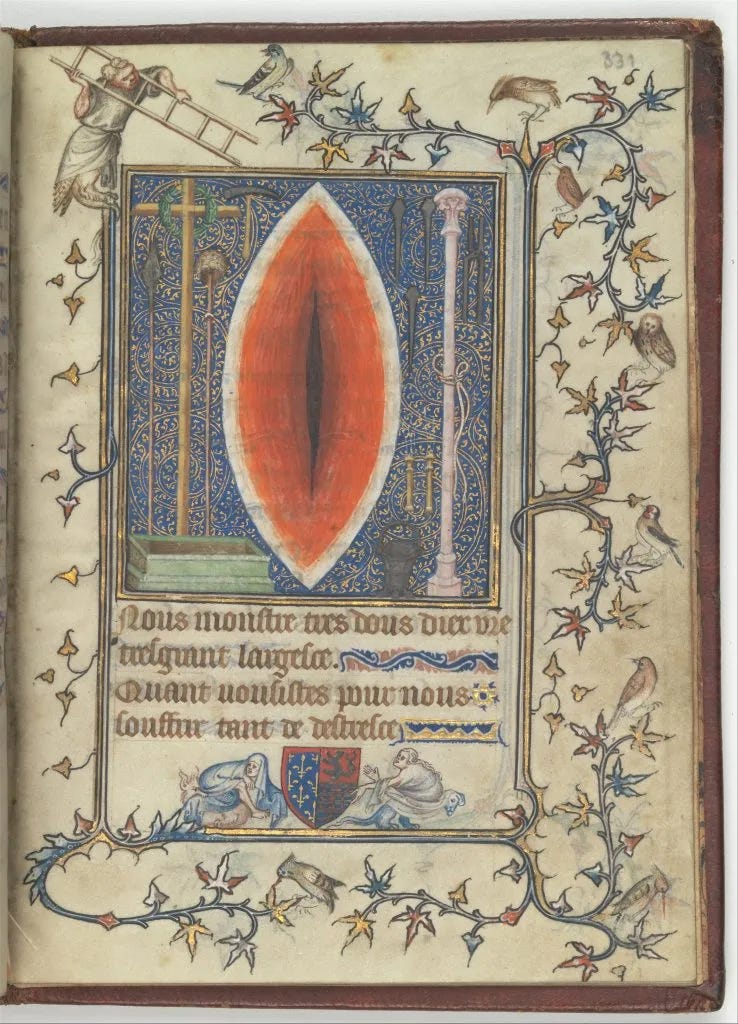
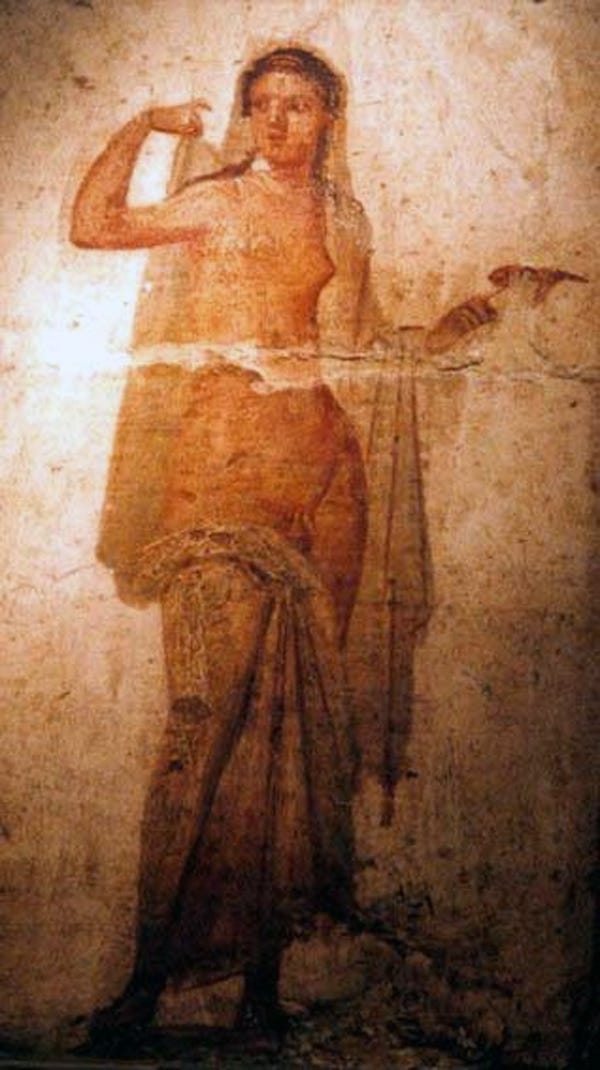
In this context we must now consider that one unique element of the bridal mysticism of the Christian religion, not itself unique as sexual allegories between human and divine are a feature of many wisdom traditions, unveils its core not in a sexual way but in a way of an alchemical reintegration, the Divine Androgyne. With the coming of the Incarnation we have our restored poles of masculine and feminine, the perfect female in the cosmic figure of Mary and the perfect male in the Divine figure of Christ. The ancient myths are repeated, Mary is the virgin mother, but also the consort (the Church is the bride of Christ, but Mary is the type of the Church, the Daughter of Zion), yet in all this the virginal element is emphasised. This divine union, the reparation between Heaven and Earth is not a carnal sexual act, but something even deeper, the thing to which sex—the prelude—referred. Man is being made complete, the male and the female dyad are reintegrated. We see this on the cross, where creation is renewed, begun even, when the universal and divine Man himself gives birth. To the Medieval mind the wound in the side of Christ was explicitly vaginal, pouring forth the creative elements of water and blood which is a part of every female birth. The resurrected Christ could not properly be recognised—not because he was a ghost but because something deeper within his structure had come to the surface, his Divine androgyny. This is not the inverted hellish androgyny of the transsexual who removes his genital nature, a Satanic parody of the Great Work, this is the Divine androgyny of alchemical gold which finds Nature totally restored, complete and perfected, lacking nothing.
It is only this restored human nature, with the fullness of the male and female principles reintegrated, that we can truly know God or enjoy the beatific vision precisely because, as Saint Augustine emphasised, God is closer to us in our own hearts than we are to ourselves, but, when our hearts are divided between two sexes it cannot properly function as true heart, a perfect mirror. The mirror of the heart, once no longer struggling in the putrefaction of desiring its missing parts in the separated sex, can look clearly at the Sun of Love becoming a perfected pole in the relations between the One and His children.
None of this is to say that having become complete and no longer desiring that which is missing that intimacy or ecstasy will be lacking, but only that these goods will be revealed in a complete form. Just as the caterpillar cannot comprehend how its life beyond the chrysalis might look, sitting at dinner discussing with his fellow caterpillar how fast they may walk from leaf to leaf in their transformation, or the child satisfied with his bar of chocolate cannot comprehend his future desire and fulfilment of a sexual union with another (to borrow from CS Lewis), so too can we creatures of lead not comprehend the gnosis, the intimacy and the ecstasy of communion with our race until we have become gold in the crucible of time.
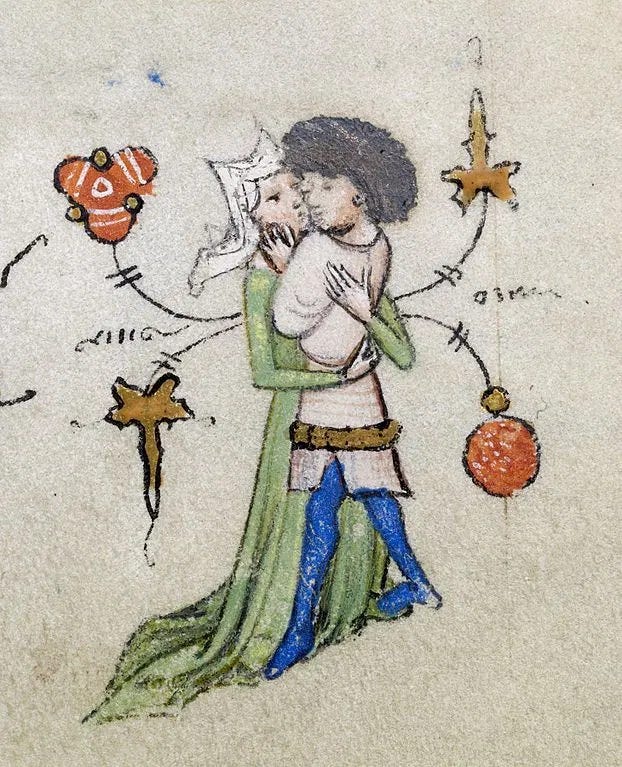
Christianity has often had room for this intimation because it is perhaps alone among the world religions to offer a vision of heaven without any images of sex, either between gods, angels or men. It is only in the Christian milieu we find the development of the chivalric romances which emphasised the polarity and purity of love between the knight and his lady whilst at the same time demanding relations remain chaste and unconsummated. They did so precisely because in the mystic quest for the Grail the powerful erotic magic which would become charged between the two was part of the journey itself, consummation would destroy it.
In the 19th century, a time of Victorian prudery and schizophrenia over the question of male female relations, the eccentric Catholic poet Coventry Patmore dared to explore the Eros of theology. His volume of poetry The Unknown Eros used provocative sensual imagery in the vein of the “Song of Solomon” which left his Victorian audience uncomfortable. But in his work we find suggestions that sexual desire only becomes truly mystical through chastity. Against the stream of common advice he suggested instead of suppressing sexual longing in order to pursue a chaste life, chastity is to be combined with intense erotic desire to fully understand the mysteries of Divine Love. In the last years of his life Patmore penned his magnum opus Sponsa Dei which fully laid out his vision for the significance of physical intimacy in religion, unfolding and exploring the themes in his earlier writings. Those who saw it described it as a masterpiece, the great Jesuit priest Gerard Manly Hopkins commented on returning his manuscript that he was “telling secrets.” Unfortunately for us, Patmore burned the manuscript in response to a slightly hysterical letter which Hopkins later penned filled with dark warnings about the contents and the abuses it could lead to. The influence of this chthonic current in Christian mysticism would later be found in no less a place than the Oxford Inklings—of CS Lewis and JRR Tolkien fame—in the life and thought of Charles Williams, a genius and eccentric Christian obsessed with themes of Divine Eros and chaste magic.
Let us tread into a final speculative arena to complete this meditation. It would seem fitting that if we are divided and incomplete and that there truly is, as Plato taught, another person somewhere on the earth and somewhere in time who is the exact missing part from each individual and that in the Eschaton a repair will be made binding two persons within one resurrected body just as the Trinity is three persons in One Being. This would create the intense intimacy which all seek in an immediate relation to one’s own being, not as extension in the world but as intention in the complete Man who is no longer becoming but is being. This would be a fitting entry into the revelation of our divine nature as gods, separating us from lower creation which can only reflect the Sun of Love statically, giving us a dyadic dynamism which would be truly creative. No longer would desire be a consequence of incompleteness, a need for repair, but it would be the desire reflecting that of God’s, who is not incomplete and in His perfection simply desires things into existence in His creative act, desire as creative agency. Man already participates in this to a limited extent though it is constantly hampered by the desires of deficit and the dysfunction of a damaged dyadic psychology. He already is creative, though due to the fall this creativity is severely limited. In his final healing his creative work would be restored and be truly like God. Here our imaginations simply fail and so with this mystery we shall close our work.
Plato, Symposium, 191a,d
Genesis 2
Symposium, 192c-e
Another way to say that is to say that the Kingdom of Heaven, as the ultimate realization of the nuptial mystery, can be compared to an orgasm that never ends. And I'm not trying to be funny or clever.
There are many good insights here. While an eschatological reality evades the limits of imagination, the mystical body of Christ intimates a wholeness that is not only inclusive of every unique person, but also the cosmos. As Hans Urs von Balthasar asserts, it is a theodramatic event that is paradoxically complete and full of surprises. Gregory of Nyssa's epektasis is wondrous, adventurous nuptiality.
Where I would push back some is in the equation of Aristophanes’ tragicomic tale of separation and Genesis. The presentation of Eve is not narrated as a result of the Fall. The God asserts that it is not good for man to be alone. Hence, the differentiation of man and woman arrives as a joyful event for Adam. He does not see Eve and groan that he has become alienated from himself. In short, the explicit discovery of a hidden responsive otherness as part of an interior kingdom now manifest in flesh is not experienced as a gnostic derailment. Rather, it makes possible a bond of unity that is predicated upon awareness of that difference coming to consciousness.