



By Carlos Perona (Europos).
The image of The One is the Two:
And if you wish to see the reality of this mystery, then you should see the wonderful representation of the intercourse that takes place between the male and the female … In that moment, the female receives the strength of the male; the male, for his part, receives the strength of the female…
—Hermes to his son Asclepius1
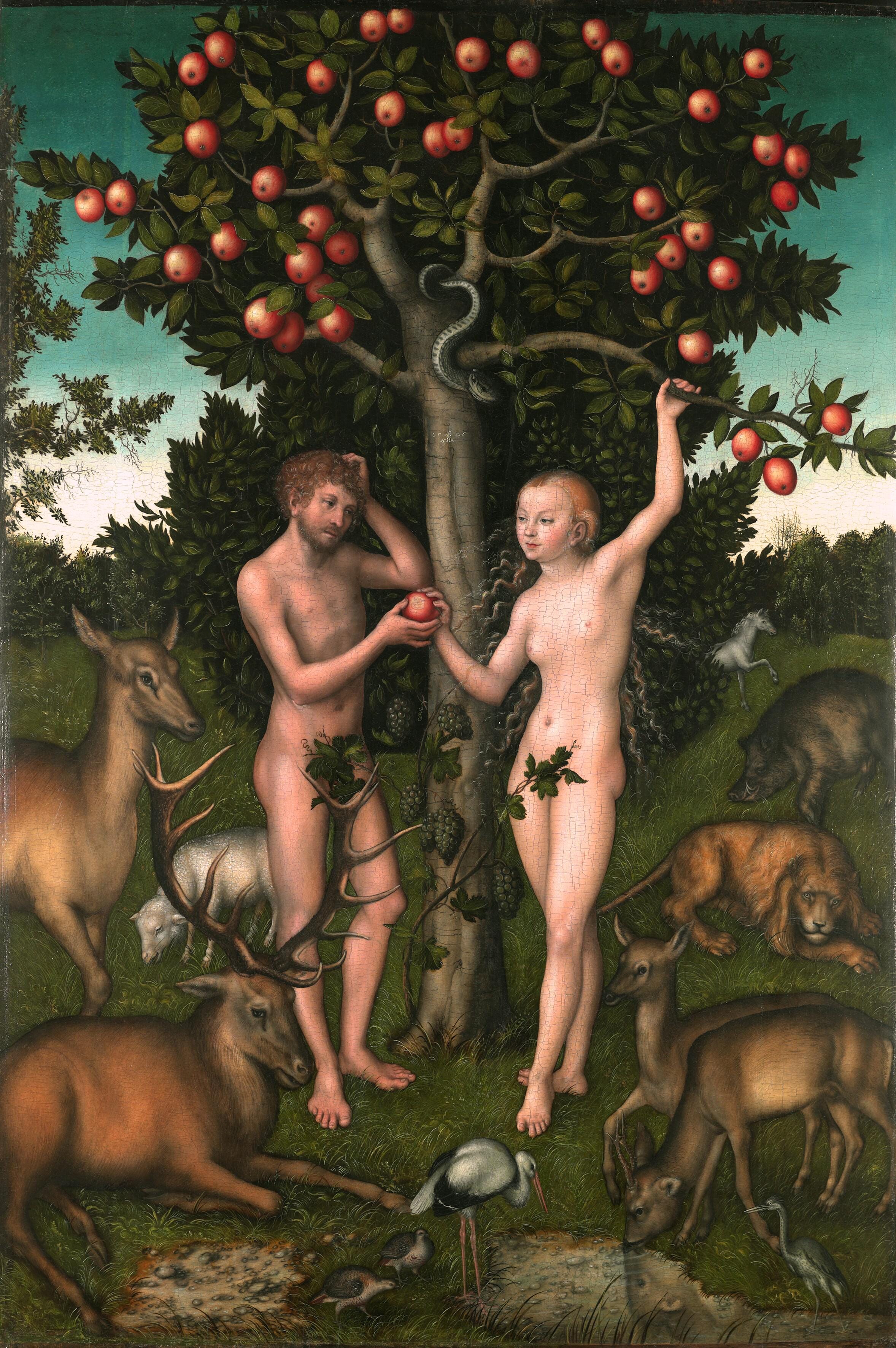
Eve after Adam
Whatever is other than God must have particular features and so is within duality—it is both principle and possibility:
In the image of God he created them; male and female he created them.
—Genesis 1:27
That which appears to be one, is therefore revealed to be two:
Then the Lord God made a woman from the rib he had taken out of the man, and he brought her to the man.
—Genesis 2:22
The Life within the Logos in John 1 parallels the emergence of Eve from Adam in Genesis 2:
In the beginning was the Word, and the Word was with The God [ho theon], and the Word was divine/god [theos]. He was with God in the beginning. Through him all things were made; without him nothing was made that has been made. In him was life, and that life was the light of all mankind. The light shines in the darkness, and the darkness has not overcome it.
—1 John 1-5
The image of Eve coming from the side of Adam presents the female spatially on the level of the male, rather than constituting a lower level of emanated reality, so to speak. The latter mistake occurs in systems that imagine The One emanating a Universal Intellect which in turn emanates a lower Universal Soul, these being “masculine” and “feminine” respectively, where masculinity is ontologically prior to femininity rather than necessarily coupled to femininity.
In reality, The One is followed by a primordial duality, for nothing but God is One: As soon as something has definite features (which it must if it is other than the Absolute) it is participating in duality. If we truly grasp a principle, we have also grasped that it exists as a set of possibilities; we understand it not only as static monad but as range of movements (male form and female flux), even if the former appears first (by analogy, the public sphere is man’s, woman’s the hearth, and some authors describe esotericism as feminine).
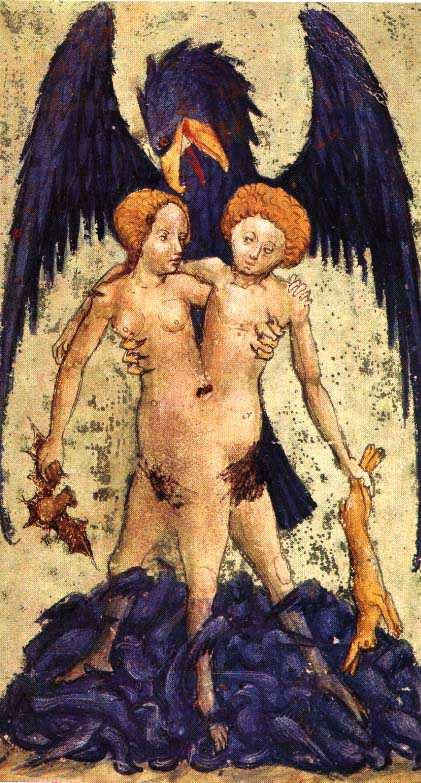
Church After Christ
When we behold Christ, we are seeing his Church as well. For this reason, Proclus was correct to disagree with certain fellow Platonists concerning the existence of a single, unique, principle after the One. To the contrary, “after” the One is already the pair, Peras and Apeiron (Son and Spirit) as it appears in multitude possible combinations (henads).
Therefore does Christ return not as androgyne, but as a Bridegroom ready to marry his Bride. Like Even from Adam, the Church comes forth from his side upon the cross, an outflowing that heals the blindness of Longinus (whose healing is a figure for conversion, transformation, Church). Christ does not heal Adam’s original wound of differentiation, but re-experiences it as wound (that is, from within the perspective of fallen humanity) and then reveals it as itself the healing miracle.
In a sense being speared is the traumatic realisation that we are porous: that we must conceive ideal forms as porous rather than hermetically sealed-off (the ideal house has windows, the ideal body has eyes, etc.). Eve coming from Adam’s side is an Edenic image for what gets experienced as side “piercing” from the fallen state, and whose meaning is then set right. The paradisal state—neo-Edenic, citizenship in the New Jerusalem—is more properly represented by a dyad, marriage, sexual embrace of man and woman, than by an “original” androgyne, therefore, because the former bears fuller (apophatic) witness to The One God.
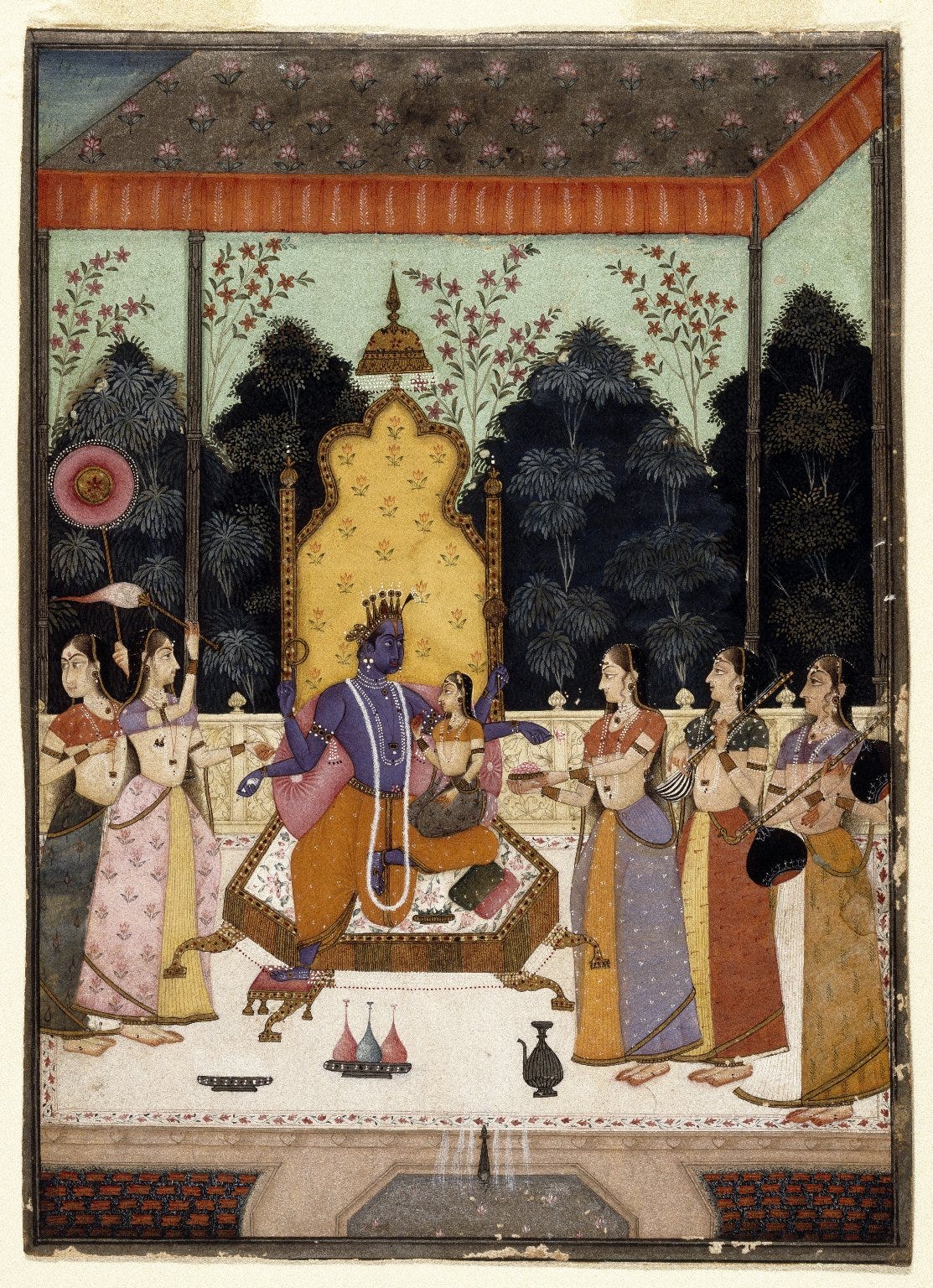
Sex and Eschaton
In Indian tradition, the Vishnu Purana and Bhagavatam Purana describe the highest Heavenly estate, called Vaikuntha, as home to spiritually liberated spouses. In Vaikuntha dwell “devotees of Vishnu along with their beautiful wives in the aerial vessels” (Bhagavatam Purana 3.15:17). These are beyond change. Their pleasures are not mere respite before another incarnation on earth (as is the case of lower heavens). A portion of the self participates in pleasure while anchored in contemplation of God without contradiction:
the goddess of Wealth (Lakshmi) of beautiful form … stays (permanently) in Hari’s [The Lord’s] residence …in her own garden, the goddess Lakshmi attended upon by her maid-servants, was worshipping the Lord
—Bhagavatam Purana 3.15:21
Therefore do we find descriptions of “damsels of big hips and beautifully smiling faces” who nonetheless “cannot with their beguiling smiles and other allurements, excite passion in those devotees whose minds are fixed on Krishna” (Bhagavatam Purana 3.15:20).
The prudish idea you sometimes find in Vaishnavist texts according to which lovemaking in the Vaikuntha must be limited to Vishnu and Lakshmi as distinct entities from their devotees is, in one sense, correct, if understood to mean that the saint, having attained to the changeless worlds, realises himself as Vishnu in relation to Laksmi, or vice-versa. A Heaven populated by units consisting of spouses on aerial vehicles in contemplation of the Divine couple, is meant as a fractal image. To contemplate the Divine couple is to become it. As the apocryphal Gospel of Philip teaches:
Bridegrooms and brides belong to the bridal chamber. No one shall be able to see the bridegroom with the bride unless he become such a one.
—Gospel of Philip 82:7 –83:2
In line with Christianity, Vaishnavism teaches that formless, contemplative absorption in the Absolute is not the highest ideal. In the Bhagavad Gita, Krishna teaches that renunciation and formless contemplation is an inferior path to that of remaining active in the world and worshiping God through forms.2 Divine simplicity is not a substance at the beginning of a causal chain, but can be contemplated at any point along the Great Chain of Being which it manifests. A state of absorption in which God is known as featureless balm is not “truer” than the perception of God through form, in act.
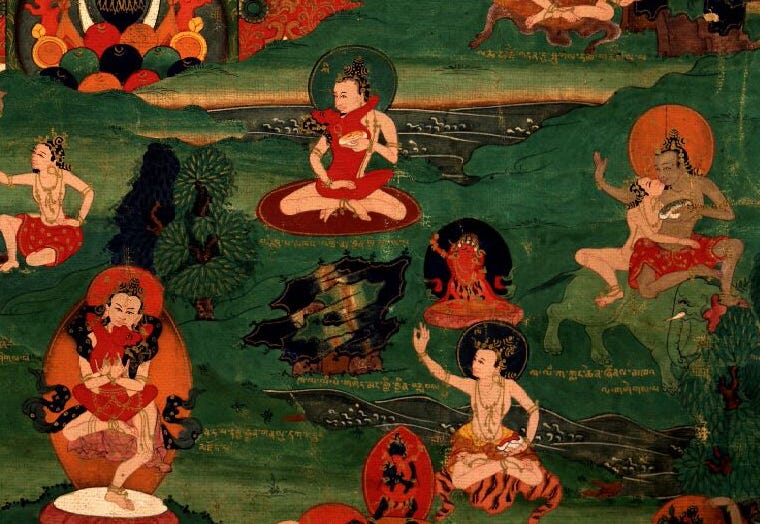
Professor of Indian Religions, Edwin Bryant, summarizes the doctrine according to which devotees “receive Brahman minds, forms and relationships, and situations in the Vaikuntha realm that reflect the nature of their Bhakti [devotion to God].” This can be understood as “merging into Krishna’s actual body and relishing the bliss of this (Bhagavat-sayunja)” becoming a little Demiurge, as Iamblichus describes it, a co-heir with Christ, per St. Paul. According to Bryant, in Vaishnavism, “God too has a divine bodily form, or more precisely, being unlimited, has unlimited divine forms, and these inhabit divine abodes, also unlimited,” which are “inconceivable: they cannot be fathomed or conceived of by the rational mind.”3 The saint’s body is a theophany, therefore, one of the “divine forms.” A sarupya body, as it is called, allows “dual Moksha” (dual liberation), a mode of spiritual liberation that maintains the duality of subject-object. The highest contemplation of God, then, includes the possibility of interacting with other selves.
The Zoroastrian Bundahishn (30:26) states that in the Resurrection “all men become immortal forever and everlasting … they give to everyone his wife, and show him his children with the wife; so they act as now in the world, but there is no begetting of children.” This seems to mean that married spouses are in familial proximity to their descendants without creating new children although they “act as now in the world” (presumably having relations). Their possibilities (children) are fully present to them. They are not given in marriage but are already united upon entering that state and are changeless in that state (hence the analogy to angels in Matthew 22:30).
On the topic of sex, St. Thomas Aquinas points out that sex is not a deficiency and, therefore, resurrected bodies will be sexed (Question 81, Article 3 of the Summa Theologica): “men will rise again … of different sex … it is in the intention of universal nature, which requires both sexes for the perfection of the human species.” Adding, however, that “there will be no lust to invite them to shameful deeds which are the cause of shame.”
Heavenly Maidens
We may understand D.H. Lawrence when, according to John Milbank, he
worried about Christianity because it appeared to him illogically (and differently from Islam in this respect) to exclude sexual relationship from the life of the resurrected body … [but] the pre-Cartesian Catholic metaphysical vision permits a much more literally sexy account of the universal possibility of love.4
Milbank also references Jean-Louis Chretien’s Symbolique du Corps to the effect that the sexual imagery of the Song of Songs is not to be taken metaphorically.
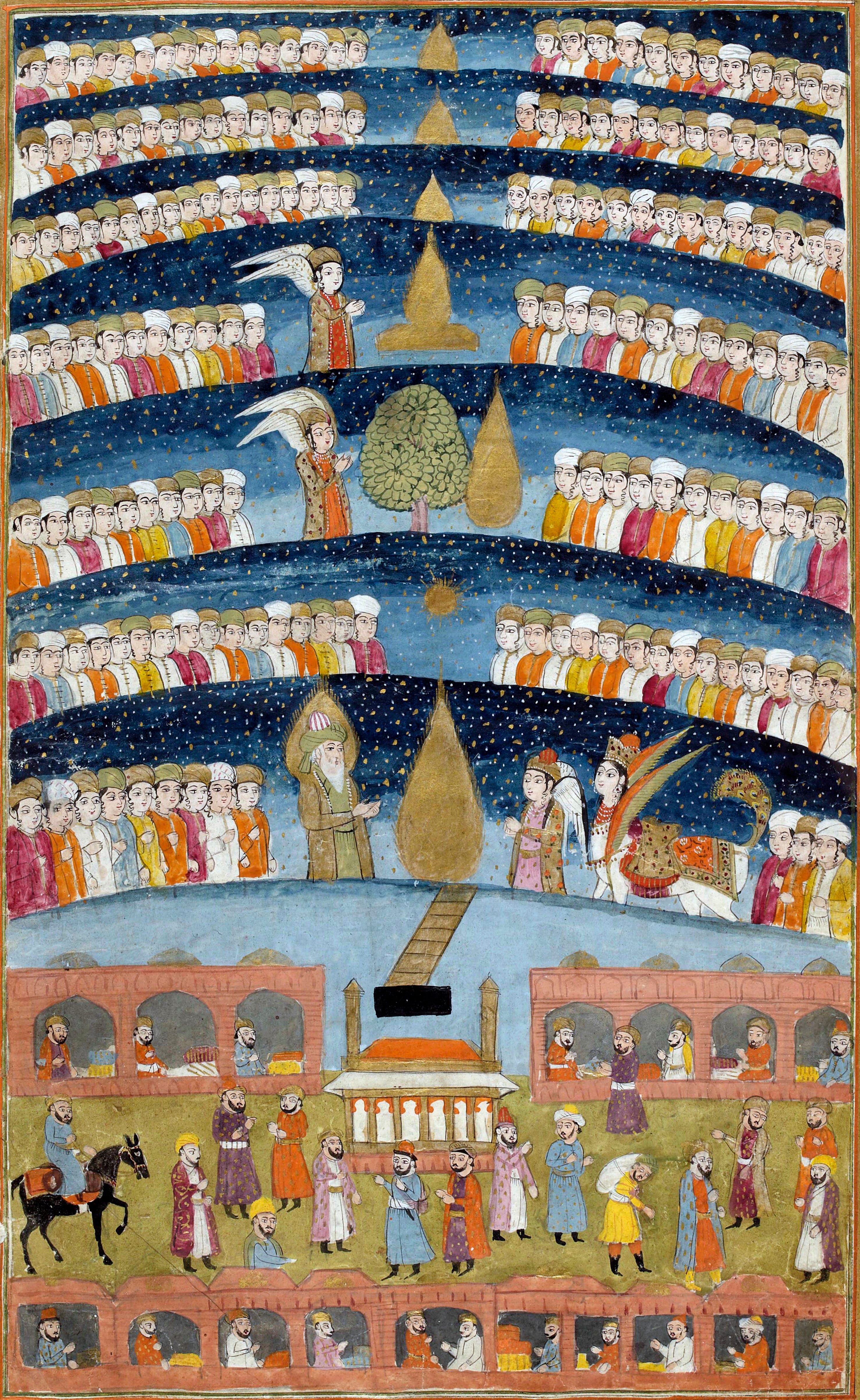
The Islamic image of Heaven, in which the male believer may engage in sexual congress with heavenly maidens or houris, and the female believer with her husband, while fully conscious of the existence of (and therefore in submission to) Allah, is actually the subtler doctrine compared to the understanding of spiritual elevation as indistinct formless entropic bliss. Abdal Hakim Murad (Tim Winter) writes in his Commentary on the Eleventh Contentions: “Our Paradise shows that the Dionysian mysteries were proleptic” (1:63) and “Unless there is Paradise, eros is a trick” (9:11).
And ibn-‘Arabi writes the following in his al-Futuhat al-Makkiyya:
The consummation of sexual intercourse is itself commended in the Law … and the sexual act of the one in this spiritual station is like the sexual union of the people of Paradise, only for the sake of pleasure, for it is the greatest manifestation which has been hidden from men and jinn, except for those servants whom God has specially chosen for it … If it did not have complete nobility indicating the weakness appropriate to servanthood, it would not have such an overwhelming pleasure which causes a person to pass away from his own strength and pretensions. It is a pleasurable subjugation, although subjugation precludes pleasure in the one who is subjugated … except in this act in particular. This nobility has escaped people, who have made it an animalistic passion from which they refrain … So what they have deemed ugly with regard to themselves is the very thing that is praiseworthy for the perfect.5
Ibn-‘Arabi’s statement that heavenly intercourse is not mere means to the end of procreation or liberation but “only for the sake of pleasure,” corresponds to the Zoroastrian Bundahishn’s “they act as now in the world, but there is no begetting of children,” for their children already are. We are not in the stream of earthly, historical disclosure but in a realm where time is more transparent to the transcendent, so to speak.
Transgression?
For ibn-Arabi, erotic enjoyment is a goal in itself and for this reason can be spiritually liberated (rather than liberating, that is, spiritual liberation occurs in it, as it, not only through it). We do not contrast the means of spiritual liberation in a Tantric sense from non-Tantric intercourse where pleasure is a legitimate end but remains distinct from spiritual liberation.6 This is not what D. D. Shulman calls the “barren eroticism”7 of (early) Tantric practices where magical-spiritual operations do not aim at enjoyment but liberation (as they understood it). It is instead consistent with certain latter-day Tantric traditions in which bhukti is mukti, pleasure is liberation.
The approximately 10th century architectural treaty the Shilpa Prakasha presents this late, less transgressive, Tantrism, no longer interested is breaking social taboo or psychological limits as supposed path to liberation. This text in particular helps explain the erotic sculptures in temples such as Khajuraho and Konarak, which, as Oxford University Professor of Hindu Studies, Gavin Flood, notes, do not seem to be like Christian cathedral grotesques, meant to ward off obscenity by depicting it, but are actually beautiful.
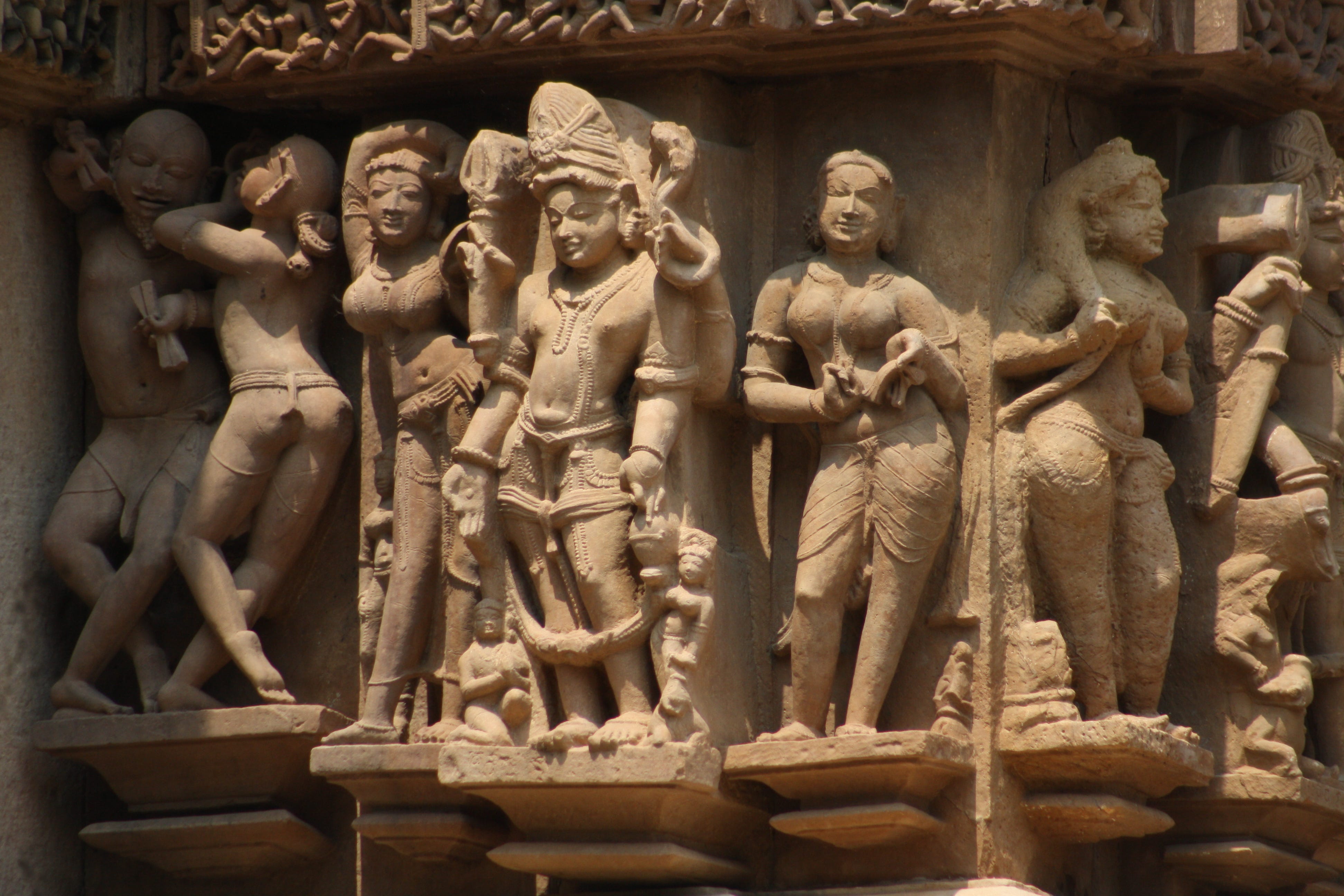
The Shilpa Prakasha recommends depictions of celestial maidens, the Surasundari, like the Buddhist Yakshi, equivalent to the Muslim Houris, Greek Kóres Sōteíras, even Norse Valkyries. Without these, it says, a temple will yield no fruit, and further recommends the presence of love images (kama kala) between maithuna couples whose absence would render a place worthy of being shunned.8 However, it does not consider actual depictions of penetrative coitus appropriate in this context, which reminds us of its non-transgressive (although the depictions of the temples mentioned do include examples that go beyond what the Shilpa Prakasha recommends). Flood concludes beautifully:
…what is significant is that maithuna couples are here directly linked to the kamasastra [pleasure], an important shift in relocating eroticism to a context of aesthetics. With the erotic carvings on temple walls, eroticism is stripped of its violence and link with death that we find in early Tantric appeasement and taboo-breaking. The depiction of the body on temple walls is a representation of the body in an idealised eroticism that is grounded in text; an eroticism which rejoices in the body yet which points beyond itself to a divine transcendence. The body’s representation here is divinised and textualised in a way that goes beyond transgression or protection. Indeed, such representation points to the sexualised body as a manifestation of the deity, as other deities on temple facades are manifestations: the temple is the body of the deity and is not devoid of sexuality.9
Apocalypse
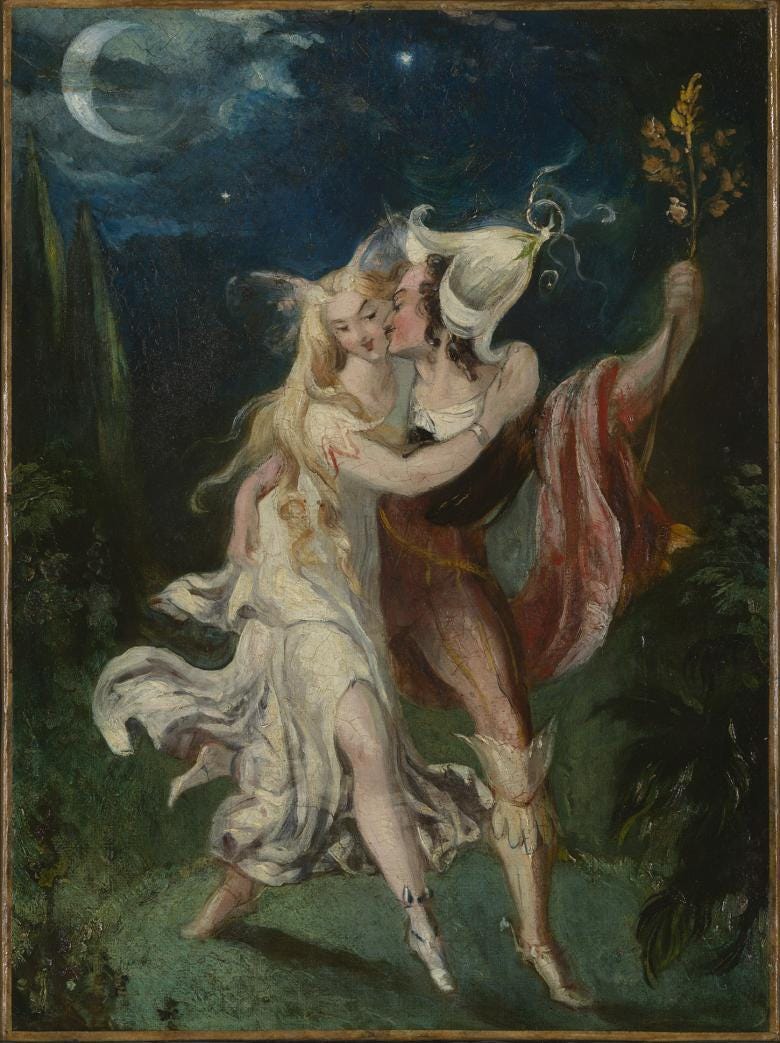
William Blake provides a vision of triumphal, apocalyptic union. First, the narrow ego is defeated, revealed for non-entity: “The Druid Spectre was Annihilate, loud thund’ring, rejoicing terrific … and at the clangor of the Arrows of Intellect.” This marks the coming of the host of beatific Eros:
The innumerable Chariots of the Almighty appear’d in Heaven
…A Sun of blood red wrath surrounding heaven on all sides around,
Glorious, incomprehensible by Mortal Man, and each Chariot was Sexual Twofold.
And every Man stood Fourfold, each Four Faces had, One to the west
One toward the East One to the South One to the North. the Horses Fourfold10
Blake’s “Four Faces” remind of the Indian story of the patriarch Svayambhuva Manu who grows four faces in order to gaze always on the beauty of his wife Shatarupa, no matter what direction she goes in. He thus transforms into an encompassing, universal being. And Blake’s chariots are like the Indian Vimana whereon heavenly spouses contemplate the Divine. As in the Persian Bundahishn, the Gospel of Philip, the Qur’an and currents of Indian tradition, for Blakean Christianity salvation is sexual.
The seventy-two nations listed in Genesis and elsewhere are divisible by the twelve gates of the Heavenly city in the Apocalypse, which implies their integral inclusion. They are the constituents of ideal humanity personified as Bride, even as Islamic tradition speaks of seventy-two houris in Paradise. There is a hadith according to which women condemned to hell may enter heaven through soteriological marriage to a saved man, so that seventy of the believer’s seventy-two wives are said to proceed from those women sent to hell. Of course hadiths are generally spurious, and often contradict the Qur’an, but these can be interpreted according to metaphysical principles, where plurality, or the feminine, is redeemed along with singularity, the masculine, in its being indexed to the singular, so to speak. Diversity as witness to unity.
Love, Eros
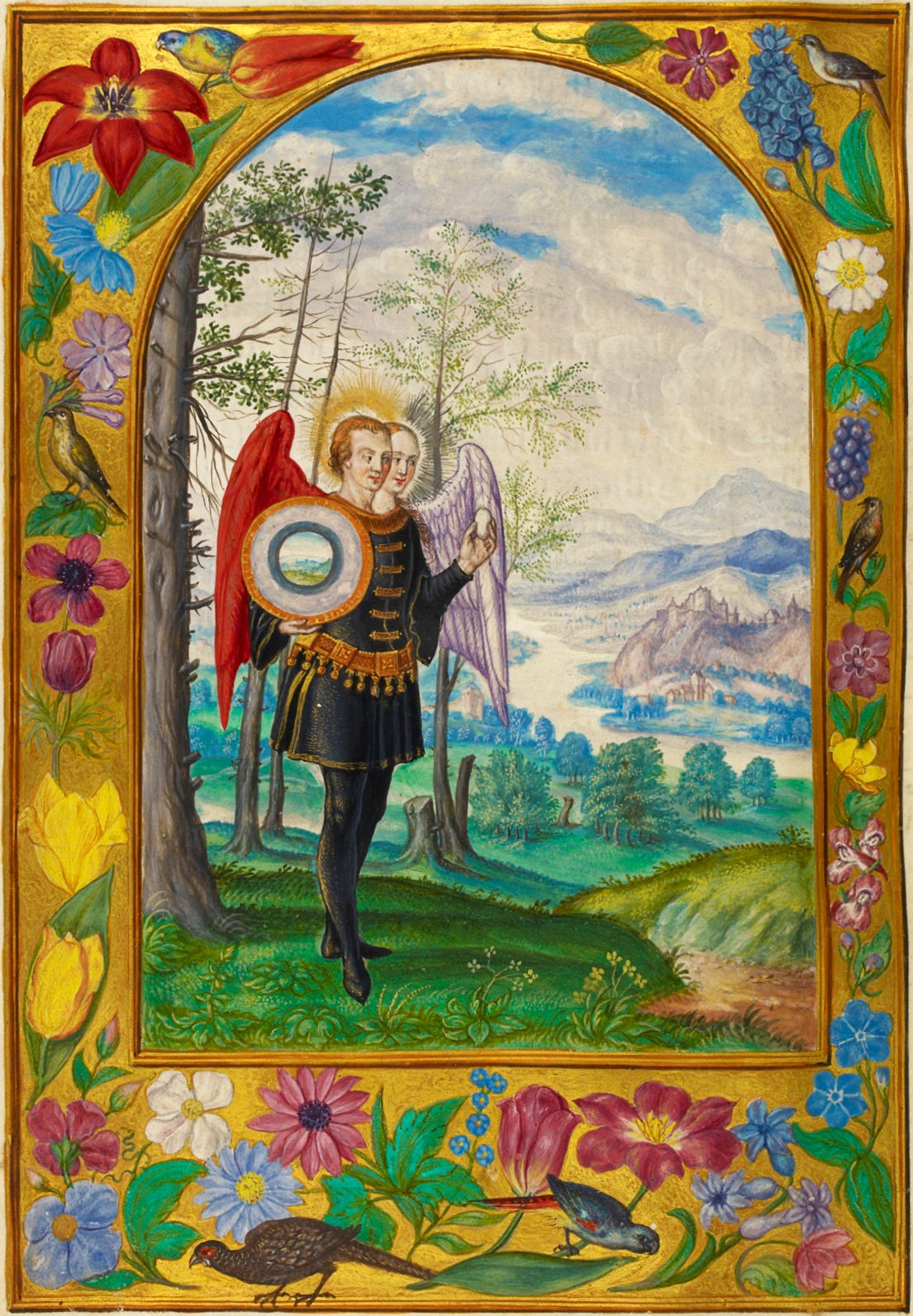
Of course centrality and harmony are not only expressed in conjugal union. Love as movement of relatedness of peripheries to centers, always encompassing, always exceeding occurs in filial piety or martial fealty, etc. In Vaishnavist terms, these can even constitute different Bhava (meaning “loving relationships” to God, like parent to child, friend to friend, lover to lover, etc.).11 In erotic love, however, one partner does not generate or potentially become the other. They are, rather, the means of bringing life about together (unlike the love between brothers or charitable love or universal love towards all things).12
Divine oneness is not itself masculine or feminine, God is not the principle of centrality any more than that of harmonious relationality; not the center (which is everywhere) any more than the circumference (which is nowhere), but He manifests as both, to paraphrase Cusa. The Divine couple in visions of Vaikuntha is both. Neither man nor woman exhausts the divine oneness, which is why we should either leave the center of sacred images empty (like the empty space at the center of the Rose-Cross or the hollow of a seed) or represent it as a two things embraced, per some Buddhist mandalas—God’s “image” as man and woman.
Asclepius 21 –29/Nag Hammadi Codex VI.8.
Spiritual liberation can include: “…residing in the same abode as Vishnu (salokya), having the same opulence as Him (sarsti), being close to Him (samipya), having the same form as Him (sarupya), and merging into Him (ekatvam)” (Bhagavatam Purana III:29:12‑14).
Edwin Bryant, Bhakti Yoga: Tales and Teachings from the Bhagavata Purana, 120.
John Milbank and Slavoj Zizek, The Monstrosity of Christ (MIT: Cambridge, Massachusetts, 2009), 225.
Muhyi’l-Din Ibn-al-Arabi, . al-Futuhat al-makkiyya (Beirut: Dar Sadir, 1966), II, 573‑574.
Gavin Flood, The Tantric Body: The Secret Tradition of Hindu Religion, 86‑-87.
David D. Shulman, Tamil Temple Myths: Sacrifice and Divine Marriage in the South Indian Saiva Tradition (Princeton, New Jersey: Princeton University Press, 1980), 261 –262. Cited by Flood, The Tantric Body: The Secret Tradition of Hindu Religion, 85.
Vidya Dehejia, The Body Adorned: Sacred and Profane in Indian Art (New York: Columbia University Press, 2009), 103.
Gavin Flood, The Tantric Body: The Secret Tradition of Hindu Religion, 87.
William Blake, Jerusalem, Chapter IV, 98, lines 6-13
Edwin Bryant, Bhakti Yoga, 115.
Henry Corbin writes the following about Ibn ‘Arabi: “The union of the masculine and the feminine is only the aspect, in the sensible world, of a structure repeated on every plane of being … we should also relate Ibn-Arabi’s extraordinary dream, in which a nuptial union is concluded with each of the cosmic powers, the stars of the Sky.”
Impressive 🌟 thank you for your helpful article ✨️
Yeah okay I like the meditation. But all the Vedanta and Islam references do not really jive with Jesus response to the Sadducees - do they?