


By Brian Scarffe, Soothsayer Founder
As a Platonist, and one who spends a lot of time immersed in the works of the School of Chartres, I am very concerned with the problem of remembrance and forgetting. Old Man Time is a cruel figure and continually steals the riches which our ancestors had prepared to hand down to us. Unfortunately, a feature of the Catholic Church in the modern world is that it seems positively enthusiastic in participating in his work. Many of my own efforts, both through the Gnostalgia podcast and here at Soothsayer, are focused on retrieving forgotten aspects of Christian spirituality and particularly highlighting that just because something is forgotten doesn’t mean that it is insignificant.
Take the saints, for instance. A person’s sainthood and their work on our behalf in the heavenly realms before the Throne of Judgment don’t diminish when the remembrance of their personhood, sainthood, or cult diminishes, though surely their influence on the temporal plane must recede as the bonds of relationship are forgotten by the way. Liturgical calendars were once filled with truly local festivals. Local in the sense that they reflected the place in which the calendar was celebrated, and local because so many of the saints within that calendar had blessed that particular landscape during their time on Earth.
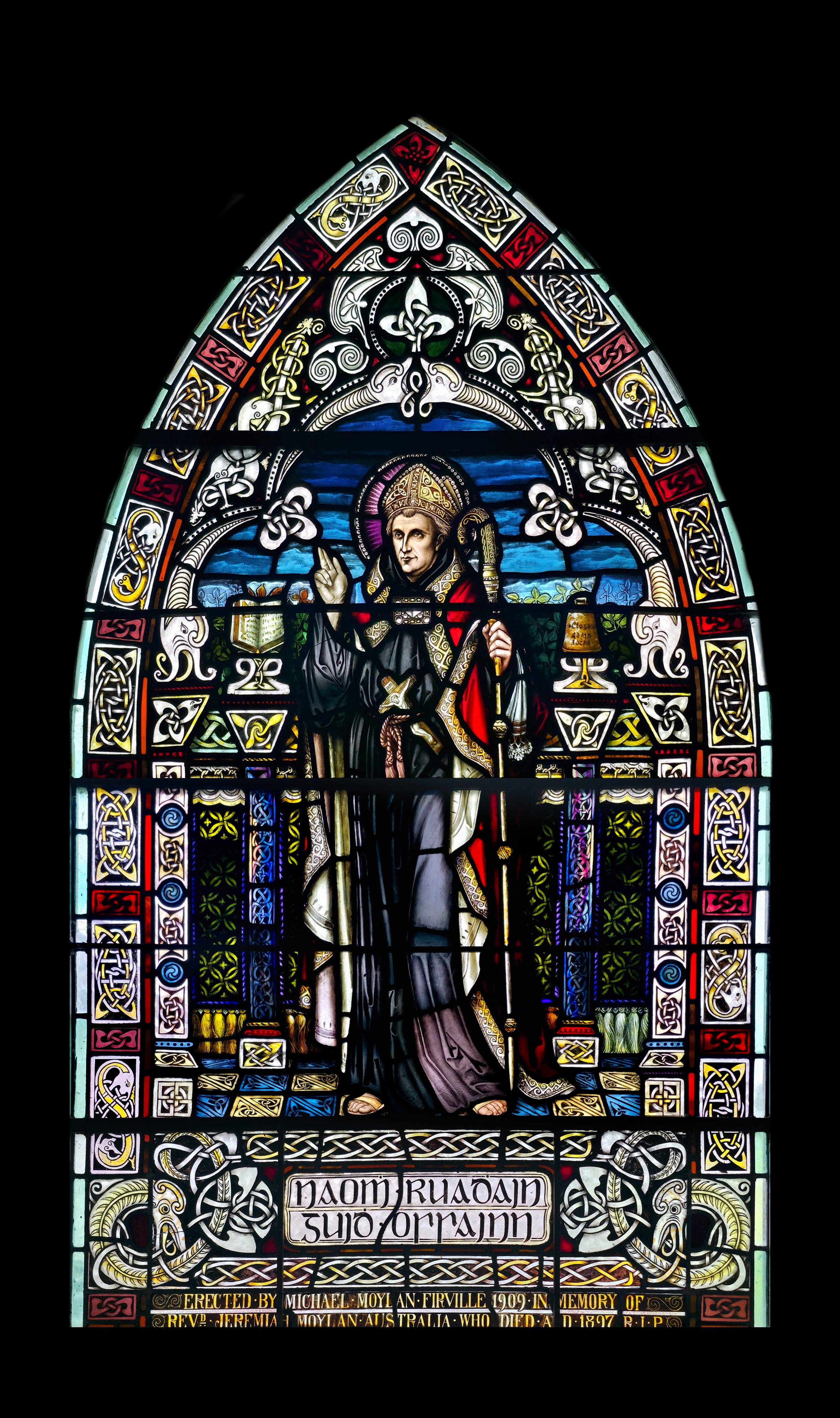
Some examples of these ancient forgotten saints include Saint Ruadán of Lorrha, a sixth-century Irish abbot who had a confrontation with the local King Diarmait over a runaway taken from the saint’s protection. Ruadán and his disciples chant imprecatory psalms and ring special cursing bells against the king, declaring that Tara, the seat of the king’s power, will become deserted until Judgment Day. I have written in more depth about Christian cursing elsewhere. The king and his men retaliate with their own curses before recognizing the saint’s greater standing with God, conceding to the saint’s demands, but stipulating required compensation before releasing his fugitive.
In a development which is sure to rankle the ears of a Church utterly disenchanted and captured by rationalist visions of history, thirty beautiful blue horses emerge from the sea, allowing the saint to race them against the horses of Tara, defeating them in the process. Ruadán gives these preternatural beasts to the king who distributes them among his nobles. But subsequently they return to the sea from whence they came, leaving the king and his retinue empty-handed. Ruadán leaves in peace with the captive, giving away his chariot horses to the local lepers, whilst heaven steps in and provides him with two stags from the woods, which harness themselves to his chariot and carry him home, sealing his sanctity before all.1

Another wonderful but forgotten early Irish saint is Saint Gobnait of Ballyvourney, likely also from the 6th century. Her life is filled with magical encounters with animals, such as a particular pilgrimage she undertakes, only ending when she finds nine white deer. She has a close association with bees and the healing and protection of the community which grows around her. Folklore passes down to us how she once raised a beehive before the bees became armed soldiers.
The devotions to her and the imploring of her help for healing involve an unusual practice of measuring her wooden statue with ribbons, touching its length and encircling parts of its body before kissing the statue and retaining those same ribbons for healing. In particular, this was used for the relief of sore throats and other minor ailments. She likewise was sought for help in getting pregnant, with one particular naked female carving associated with her surviving on a ruined church where an ancient local tradition prescribed touching the carving and then one’s own body, leading to pregnancy.
I often meditate on how wonderfully strange the Christianity of my ancestors was, particularly while travelling through the sacred landscape in which they lived. So much of Britain has now been utterly suffocated by the great satanic mills of which Blake warned, yet there are still glimpses of the old ways.
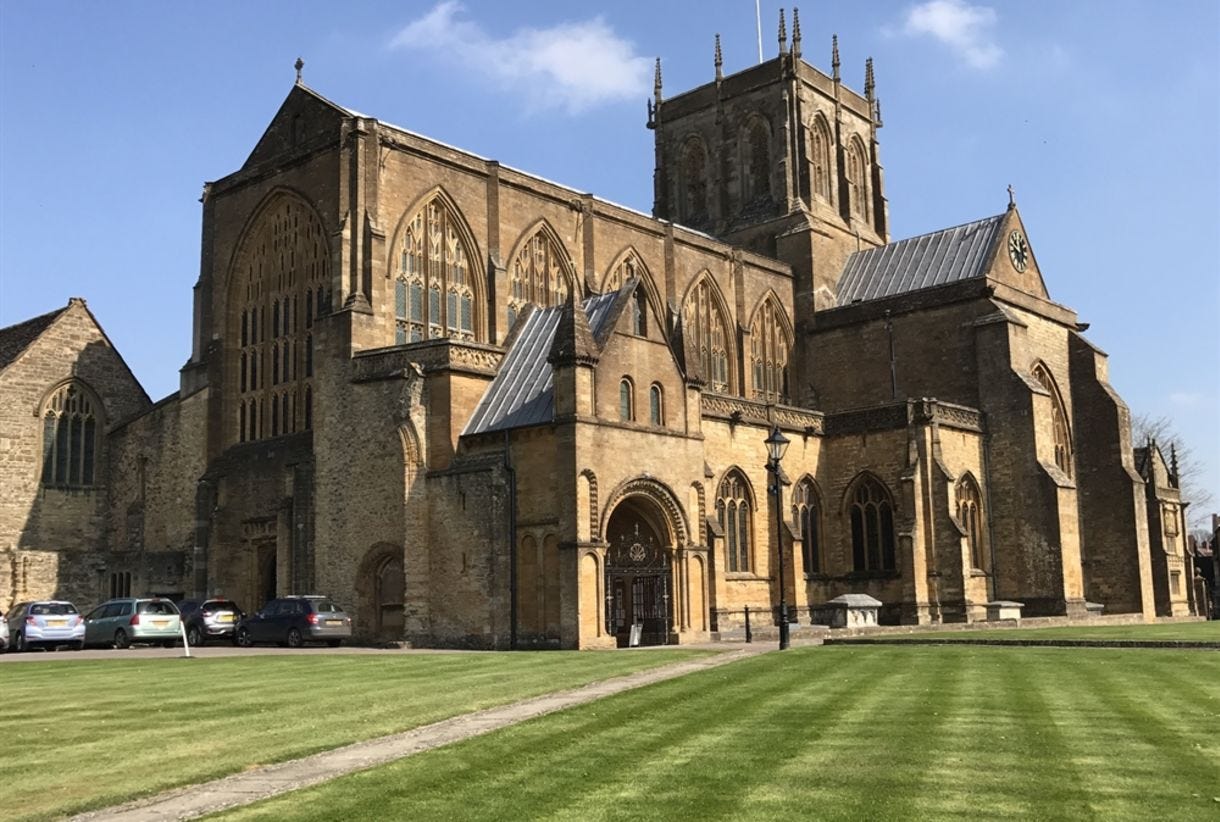
Recently, I was driving through the West Country and I came upon the enchanted town of Sherborne, a truly ancient settlement which has links to the primordial Celtic Church, and a very early Anglo-Saxon monastery emerged before becoming both an episcopal seat and a significant place of monastic learning. Wandering through the town today and the buildings constructed with its soothing honey-coloured stone, one can still feel the presence of the holiness of more than fifteen hundred years of Christ’s blessed work in this tiny forgotten town at the back end of Dorset.
Its church, the once Sherborne Abbey, is considered to be one of the most beautiful examples of Norman architecture found anywhere in the country today. And sitting there quietly, contemplating the mysteries of my ancestral faith, I hope one day I will hear the angels sing, and that my soul will become sensitive enough to the local saints that a deep communion between us will be opened.
Sherborne Abbey is, of course, in possession of its own forgotten saints. One in particular is Saint Heahmund, Bishop and Martyr. Saint Heahmund of Sherborne was a ninth-century Anglo-Saxon bishop who fought and died alongside Saint Alfred the Great, whose blessed reign established much of the seedbed which would become our great English land and character. I have a particular devotion to Saint Alfred, for not only is one of my godsons named after him, but he is one of my own ancestors, through the lineage he establishes, running through Saint Margaret of Scotland and later the Percys and the Kynastons. This for me is baptized ancestor worship. For I, like so many whose heritage is on this island, have a great cloud of witnesses, my own forefathers and mothers, watching over me from the heavenly realms and to them am I devoted, above and beyond the centralized and prescribed Saints of the Uniform Liturgical Calendar of No Place.
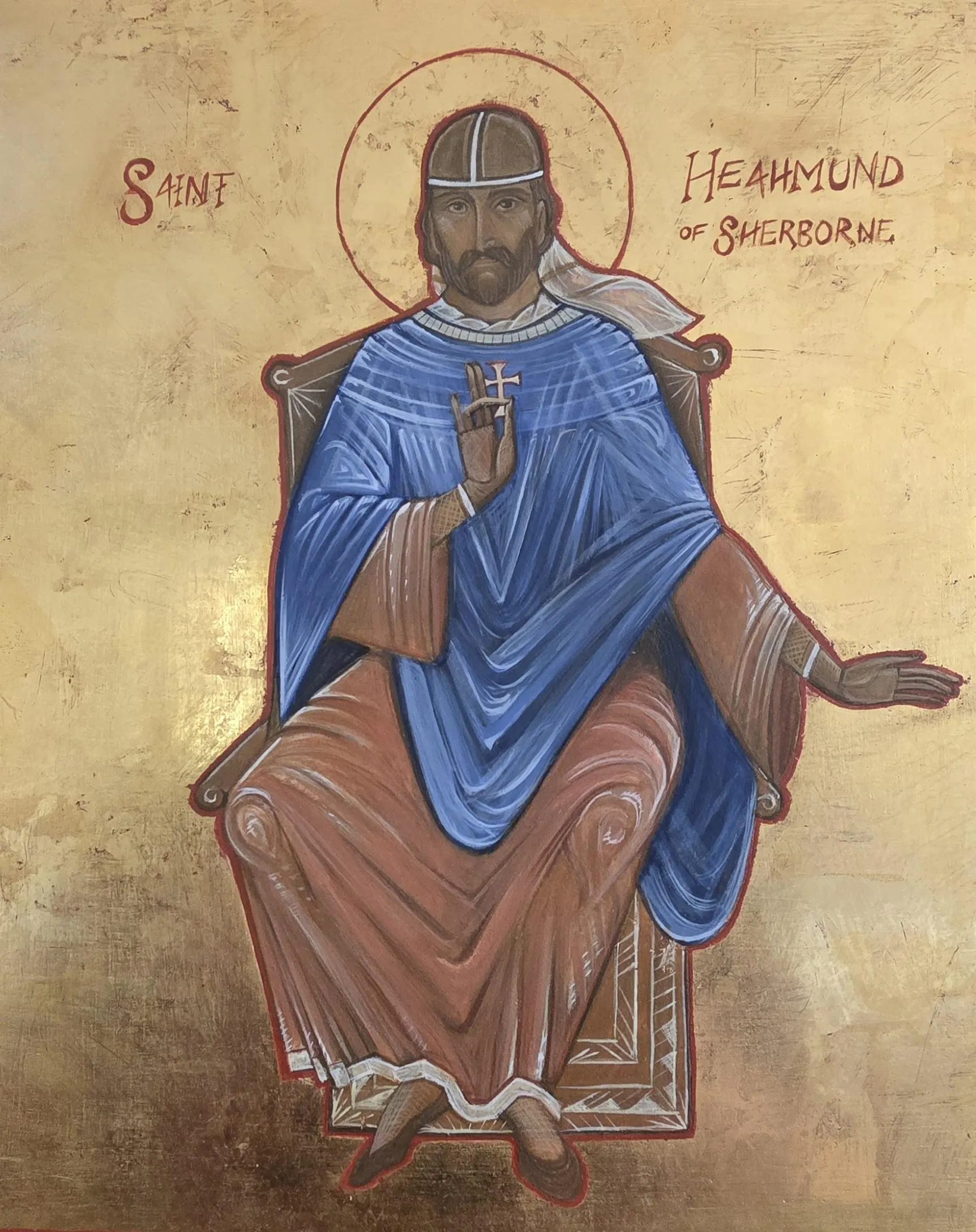
Though largely forgotten in today’s Church—astonishingly, not a single church, chapel or monastery remains dedicated to his name—Saint Heahmund is not an insignificant figure for several reasons. Firstly, as a warrior bishop, he is a shining exemplar of a shepherd willing to lay down his life for his sheep, and understanding that sometimes it is necessary to take up the sword to defeat evil, in this case, the invading rapacious Danish tribes. But secondly, and more importantly, he was considered a martyr by the medieval Church for dying in battle against the pagan Enemies of Peace. The thirteenth-century Roger of Wendover’s Flores Historiarum and the similarly titled sister work of Matthew of Westminster from the following century explicitly express that in falling on the field of battle with his fellow Christian countrymen, he receives the “crown of martyrdom”. Before his memory was dropped on the path of history, his cult was celebrated on the feast day, the 22nd of March, the day in which he fell in battle.
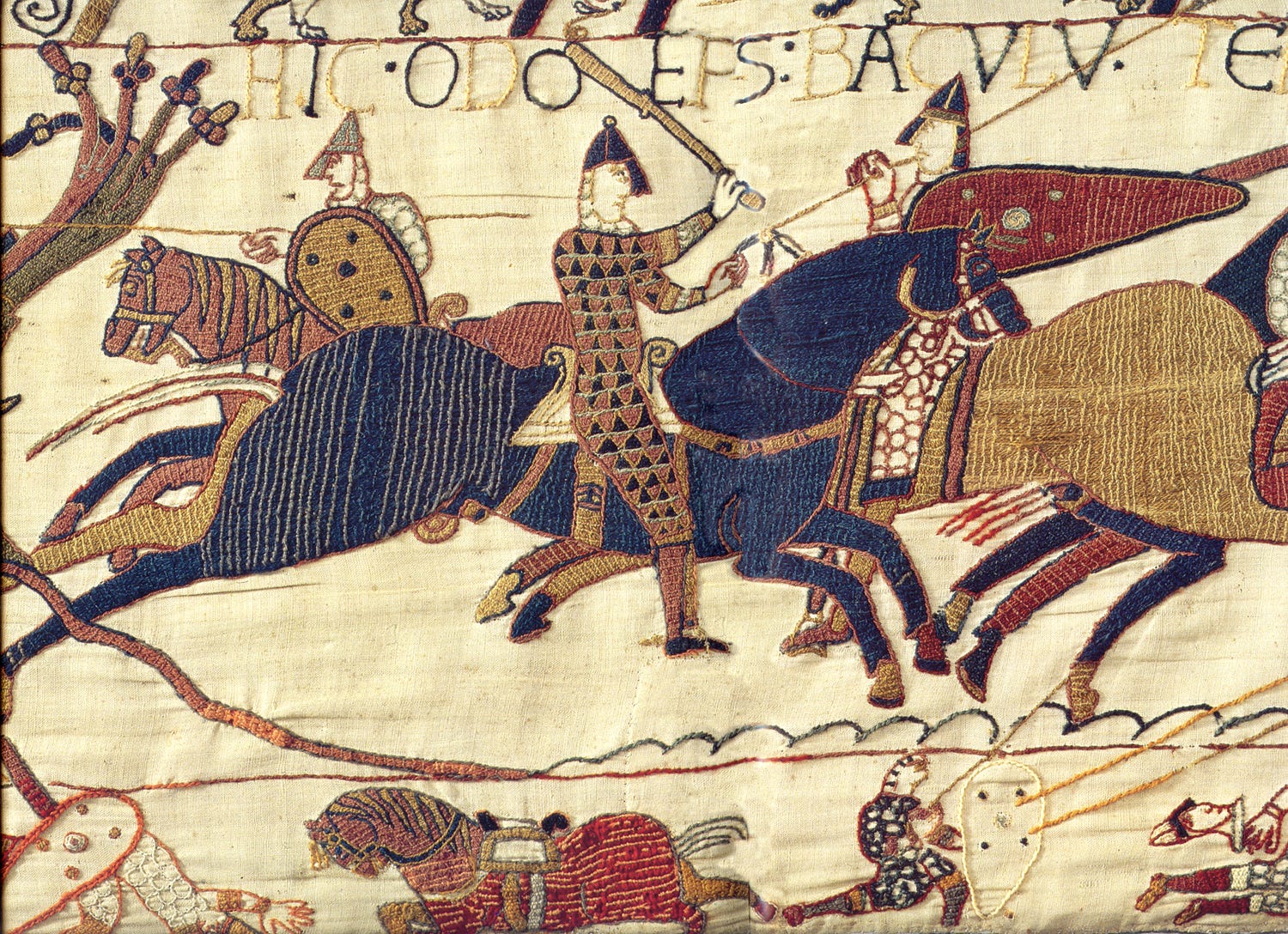
It is quite possible that this hallowed warrior bishop carried a sword into battle, and it was only later attempts at adding a historical fig leaf of piety which led people to believe that warrior bishops only carried clubs so that blood would not be drawn. The most common form of evidence in support of this is the imagery of Bishop Odo, fighting with a club, fighting with a mace in the imagery. However, the problem is that Odo’s own seal shows him as an equestrian warrior with a sword in hand. It wouldn’t be until the 12th century that more explicit canonical prohibitions would come into place against this sort of episcopal activity. And yet, even then, bishops continued to wield the sword in exceptional circumstances.
The reader may be astonished to discover that the English Church has a particular hallowed (sainted) bishop who is considered a martyr for having died in battle. In order that this might make more sense to us as modern and spiritually leprous Christians, let us try and enter into the mind of the Anglo-Saxon Church. For this, fortunately, we have a wealth of readings, including sermons, which can reveal to us how we might better see the world. No doubt the reader has listened to an uncountable number of shallow and perhaps even spiritually damaging homilies filled with platitudes and whose message can be distilled into “be nice, say your prayers, accept everyone”.
In contrast to this, I am reminded of Ælfric’s Assumption Homily. Ælfric was an English Benedictine author writing around the end of the 10th century. In his homily, the monk tells his listeners of a story that happens between Saint Basil the Great, the bishop in the East, and Julian the Emperor, an apostate from Christianity. When Julian meets Basil on his march against Persia, he boasts of his superior learning. Basil, in turn, offers him three barley loaves, his own food, in a gesture of blessing. Julian, however, taking this good act spitefully, retaliates by giving Basil grass and throwing his bread to the animals. Saint Basil protests these insults, and in response, Julian threatens to demolish the city in which he lives, turning it into grazing land.
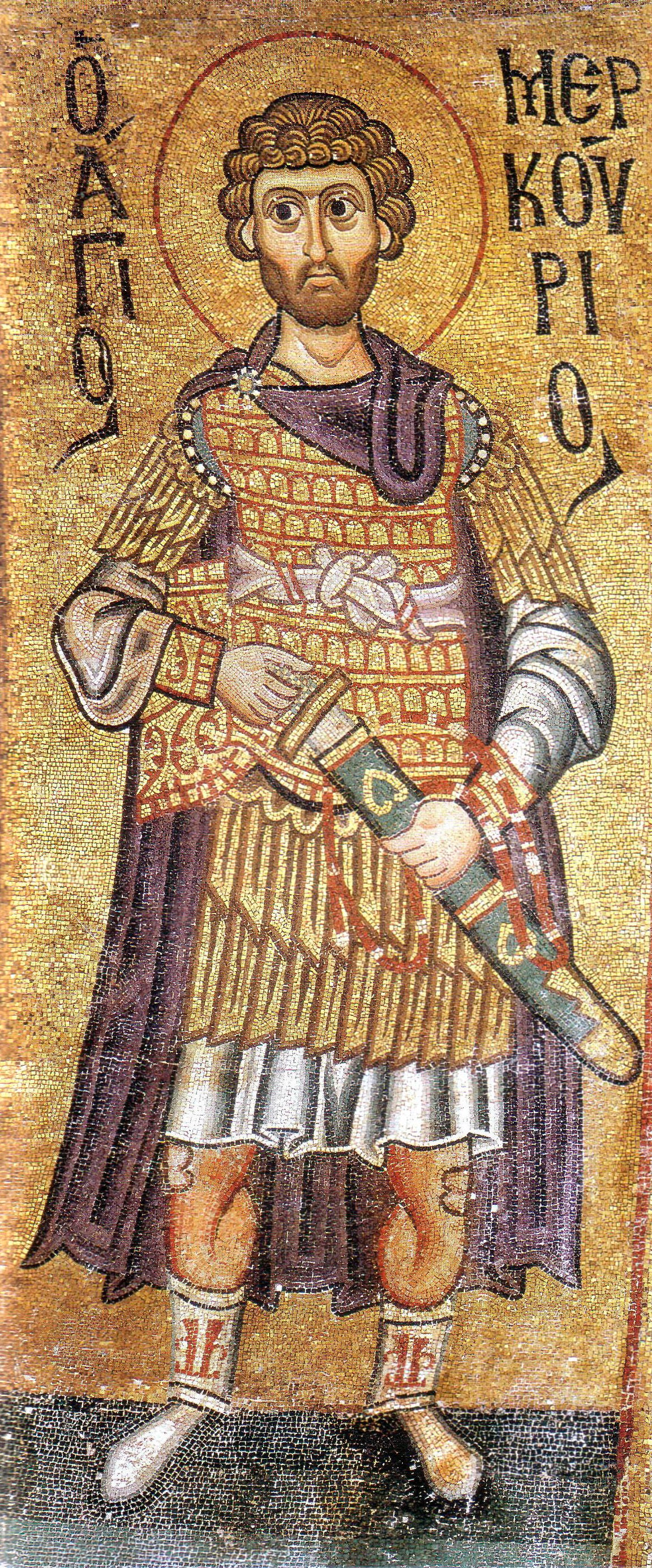
At this, Saint Basil gathers the subjects of his city into a church dedicated to Mary, where everyone fasts for three days, and on the third night, he sees a vision of Mary enthroned amid a great heavenly army. The Queen of Heaven summons the saint and martyr Mercurius and orders him to kill Julian. The martyr appears armed and departs. Basil visits the saint’s shrine to discover his weapons have disappeared. And then again later, when the spear returns, it is bloodstained. Three days later, one of Julian’s officers, Libanius, arrives at Saint Basil requesting a baptism, as despite the serious guard watching the emperor, an unknown warrior had appeared, piercing him through and vanishing. Julian had died screaming. Then the monk Ælfric explains the strangest detail: the martyr had travelled from heaven with a physical weapon and stabbed Julian before his guards’ eyes: “his spirit swiftly went, and with a bodily weapon stabbed the foe of God”.2 The monk finishes his homily by urging his hearers to seek Mary’s intercession in their own distress.
Here, then, is the strangeness of Anglo-Saxon Christianity. This is a faith in which heaven defends its flock and participates in the warfare of men. Such stories were common. Another incident occurred when the Northumbrian king Oswald went to war against Cadwallon. In the early 7th century, the great Celtic saint Columba appears to the king, towering above the camp and spreading his shining garment over much of the army. He then encourages Oswald and promises him victory. And so, the Northumbrian king overcame his enemies.3 Similar posthumous miracles are associated with Saint Edmund, a particularly powerful English exemplar. We are told by Herman the Archdeacon, writing sometime in the late 11th century, how when the villainous Sweyn Forkbeard demanded tribute from the Anglo-Saxons, Saint Edmund would appear to him and strike him with a lance, causing him to die.4 So heaven looks after her fold.
Saint Heahmund is a saint whose cult is ripe to be restored, for he is a saint for our time. We Englishmen are being invaded once again by vast numbers of foreign militants who are even now raping and murdering across the land. Treachery is everywhere, and the King’s ministers, instead of protecting their wards, have abandoned their duty, losing the mandate of heaven, using all their powers to cover up the crimes and to spread these rapine invaders to every corner of the land, so that the once quiet and peaceful countryside, which until only a decade ago we inhabited, is now increasingly taking on the character of the lawless parts of the Middle East. Journalists and NGOs are participating in this invasion. But worst of all, so is the Church. The Church is using all of her wealth and her might to facilitate these crimes. And the bishops who sit on the thrones of the great saints who came before now hold little resemblance to the great shepherds of the past. I am reminded that in the previous pontificate, Pope Francis would celebrate the World Day of Migrants and Refugees Mass in Saint Peter’s Basilica, where he called for overcoming fear and welcoming newcomers as migrant atrocities continued throughout the continent. In one particular incident, an 18-year-old girl named Pamela was murdered just weeks after the Pope’s migrant celebration by a Nigerian national who raped, murdered and then destroyed her body, dismembering it and putting the parts into two suitcases. Pope Leo likewise celebrated a Jubilee of Migrants Mass on the fifth of October 2025, whilst slaughter and rape committed by foreign invaders were becoming so commonplace that in some countries it was no longer being reported as national news.
If we find a bishop somewhere who does not have the whiff of scandal about him or who does not hate the patrimony of his ancestors, we are considered blessed. But finding a bishop who will actually stand for his people and look after the members of his own household first is unheard of now.
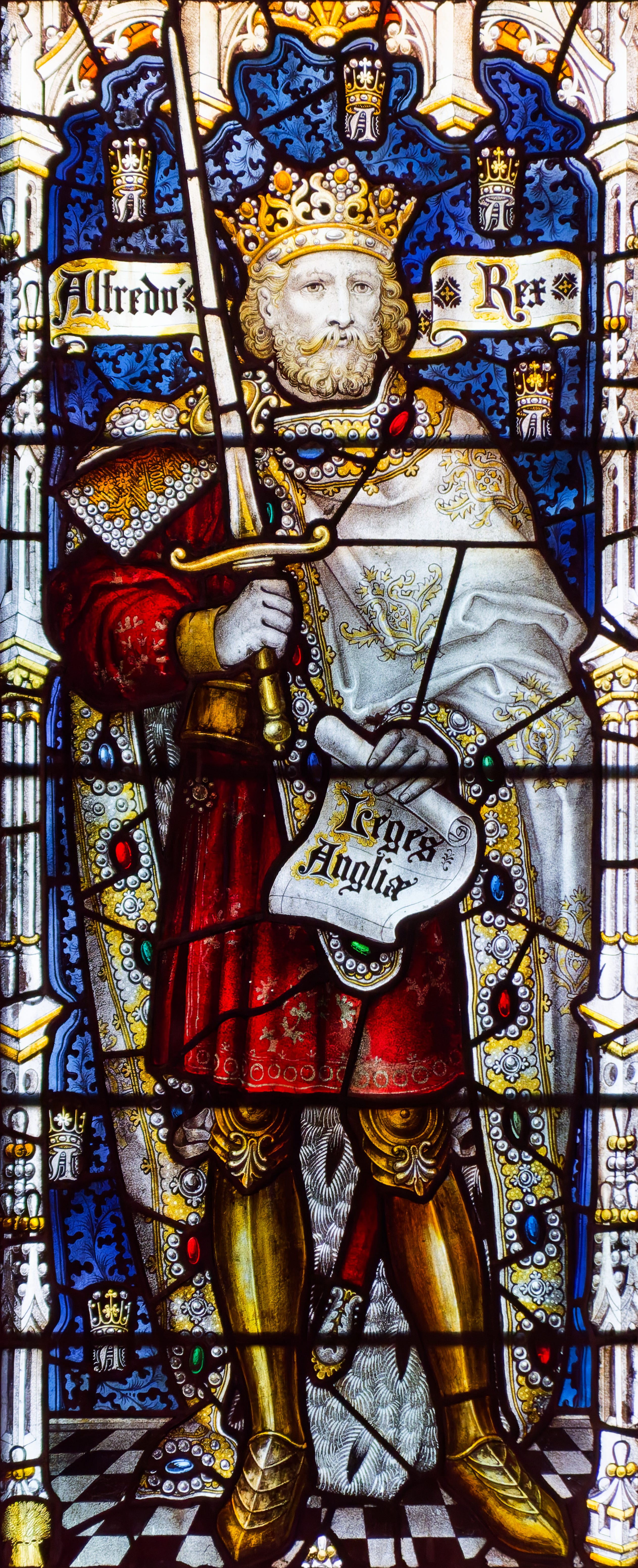
But consider this, dear reader. We are not simply abandoned by heaven to be at the mercy of these wolves in sheep’s clothing. The great saints and the magnificent bishops of the past are still here with us, their powers seeping through the ruined monasteries in which they dwelt, the chapels in which they sang, and the trees under which they prayed. The waters that flow from the holy springs bear their spiritual powers throughout the land, and their inaudible choir invisibly participates everywhere in this holy island, which, considering all of the prayers, pilgrimages, and blood spilt by these hallowed men, is itself a great relic to which holy devotion must be paid. Among these invisible spiritual flames, the warrior bishop who was martyred in battle stands in the light of the great throne, holding his sword and watching over his flock. He not only prays for us, but he waits that his cult might return, that we might remember him and pray to him and pay worship to him. Alfred the Great stands by his side. He too wields a sword. Between them, representing both the secular and the spiritual swords which rest at the fountain of this land, they await to be called on and invoked that their powers might come and strike down the wicked men which have taken this kingdom by cunning.
The forces of infernal opposition which are arrayed against this great Christian land may well have intuited that this great martyr, warrior, and shepherd of the English Christians would be a saint for this time, and so have tried to sully his name. A few years ago, the television show “Vikings” brought the bishop back as a character, a man who would stand against the invaders. But instead of representing him as an appropriately holy and pious man, a man who might inspire the viewer, they turned him into a lecherer, with one of his first scenes being that of him fornicating with a woman. The enemy is afraid. They know that if we wake up, at our disposal are spiritual resources of such magnitude that the Christian men of this land will be able to cleanse it of its disease. I am reminded here of the Saint George’s Day sermon delivered by the English Augustinian canon John Mirk to the monks at Lilleshall Abbey in Shropshire sometime in the late 14th century, in which he tells of the time when Saint George himself appeared to a priest at the siege of Jerusalem, commanding the priest to bring his relics with him to the siege. When the Christians reached Jerusalem’s walls, the Saracens defending the city were so strong that they dared not climb and attack with their ladders. But Saint George appeared. Dressed in white with a red cross upon his breast, he climbed the ladders himself, commanding the Christian knights at the wall to follow him. Thus they captured the city and killed every Saracen they found within.5

And to this, I hear rumour that young men are beginning to remember Saint Heahmund and pay homage to him. Artists, it is said, are experimenting with sacred art to open windows to heaven unto him. Other young men are rediscovering that the term Saxon has in the old tongue, the meaning knife bearer and that to be a Saxon is to be a man at arms. For we are warrior people and we have warrior shepherds who watch over us. Pilgrimages are quietly being undertaken to Keynsham in Somerset, where Æthelweard records that he was buried after his death in 871, and also to Sherborne, where he sat upon his episcopal throne. Prayers to him are being written and said with great devotion, as men prepare themselves to become vessels for the great spiritual powers which watch over us in the heavenly court. The great miraculous interventions of the saints, which litter the past of this island, will soon become present and I believe Saint Heahmund, crowned with the glory of a martyr, stands at the forefront.
Rumours of civil war are not hysterical hand-wringing. In fact, it is not even a future prediction at all. It has already arrived, though, for now, only at low intensity. Tens of thousands, if not hundreds of thousands, of young English girls have been abused by the Islamic rape gangs, whilst many men and women and children have been murdered by invading militants. Catholic politicians, too, have been killed in this war to the establishment’s deep embarrassment. They have attempted to make us forget that Sir David Amess, a great practising Catholic and longstanding Conservative MP known for his opposition to abortion and commitment to his constituents, was murdered by a Muslim militant at a constituency surgery in 2021. Similarly, this year, Ann Widdecombe, the former Conservative prisons minister and shadow home secretary, who had been outspoken for Catholic causes throughout her life, was murdered in cold blood, perhaps in odium fidei, by enemies of this Christian land. We may not want war, but war is already here. Christianity, the reader must understand, is not a bloodthirsty religion. But neither is it a pacifist gathering. Justice cannot simply lie down and be trampled. When necessary, the people of God have a duty to confront evil with force, because sometimes that is the only way to stop your neighbour—and, in fact, the members of your own household, to whom you owe love and protection—from being devoured by devils.
“Life of Ruadán”, in Bethada Náem nÉrenn, edited and translated by Charles Plummer.
Ælfric, “Homily for the Assumption of the Blessed Virgin Mary”, in The Homilies of the Anglo-Saxon Church.
Adomnán, Life of Saint Columba, Book I, chapter 1.
Herman the Archdeacon, Miracles of Saint Edmund.
John Mirk, “Sermon for Saint George’s Day”, in his Festial.
Thank you Brian for this very interesting essay. I'm reminded painfully of the treasonous invertebrates who willfuly carry out the unlawful and unjust political machinations of a satanically inspired ruling class. It seems that in every era there will be those who without question demonstrate infidelity to God, nation, past, present and future generations, by enthusiastically becoming agents of the State via media, business, law & order, education, health. The particular circumstances of state surveillance in the most intrusive ways, goes beyond Orwellian fiction. Most likely it will take another series of tragedies foisted upon the populous by the state, that will ignite the masses. Should that coincide with favourable political pressure on any one of the Uniparties, then maybe, perhaps with the will of God, we might be relieved for a while. But I'm reminded that Our Blessed Mother at Fatima told us that only by authentically consecrating Russia to Her Immaculate Heart will we see a universal period of peace, at all levels of society.