



By Carlos Perona (Europos)
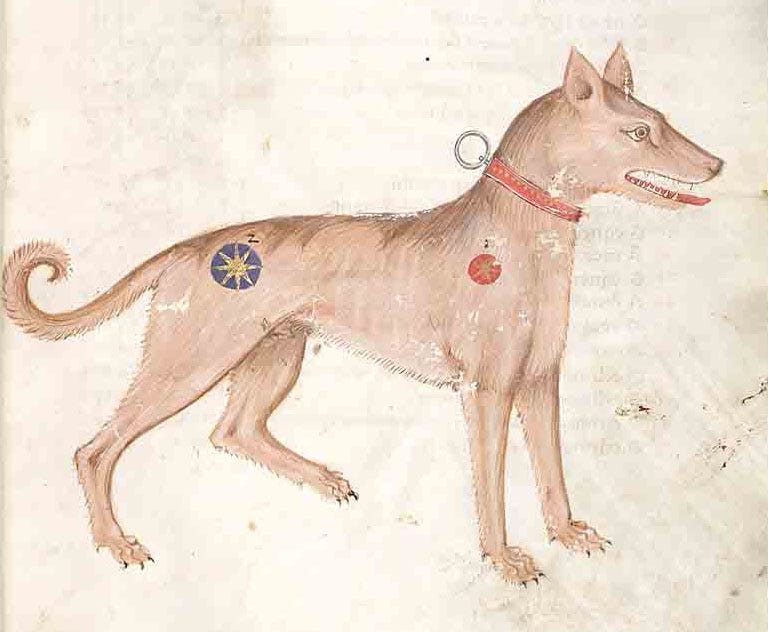
I want to trace the spiritual symbolism of dogs in the Christian tradition, beginning in with the Book of Tobit, focusing on the prominence of this symbol in the Dominican order, and concluding with Dante’s prophecy of the Greyhound and the presence of the Biblical dog into a holy Romanitas.
The Angelic Companion
Although dogs are often lowly creatures in the Bible, the Book of Tobit presents us with a dog faithfully accompanying its master on his journey (Tobit 6:1-2), mentioned once more during that master’s homecoming (11:4). This dog, who some scholars consider to have been inspired by Argos in Homer’s Odyssey, stands for loyalty, as well as protection and heralding of the master’s return.
When Tobias and his angelic companion, Raphael, set off, immediately after the first reference to the dog, a fish leaps out at them. Tobias is instructed to grab it and extract certain organs which will serve as medicine, discarding the guts, and cooking the flesh. Fish and waters are often identified with idolatrous nations in the Bible, and so we have here an early example of the Gospel’s use of the figure of the fisherman as a symbol for the missionary raising up the fish. What is valid will be taken in, what is unclean will be discarded.
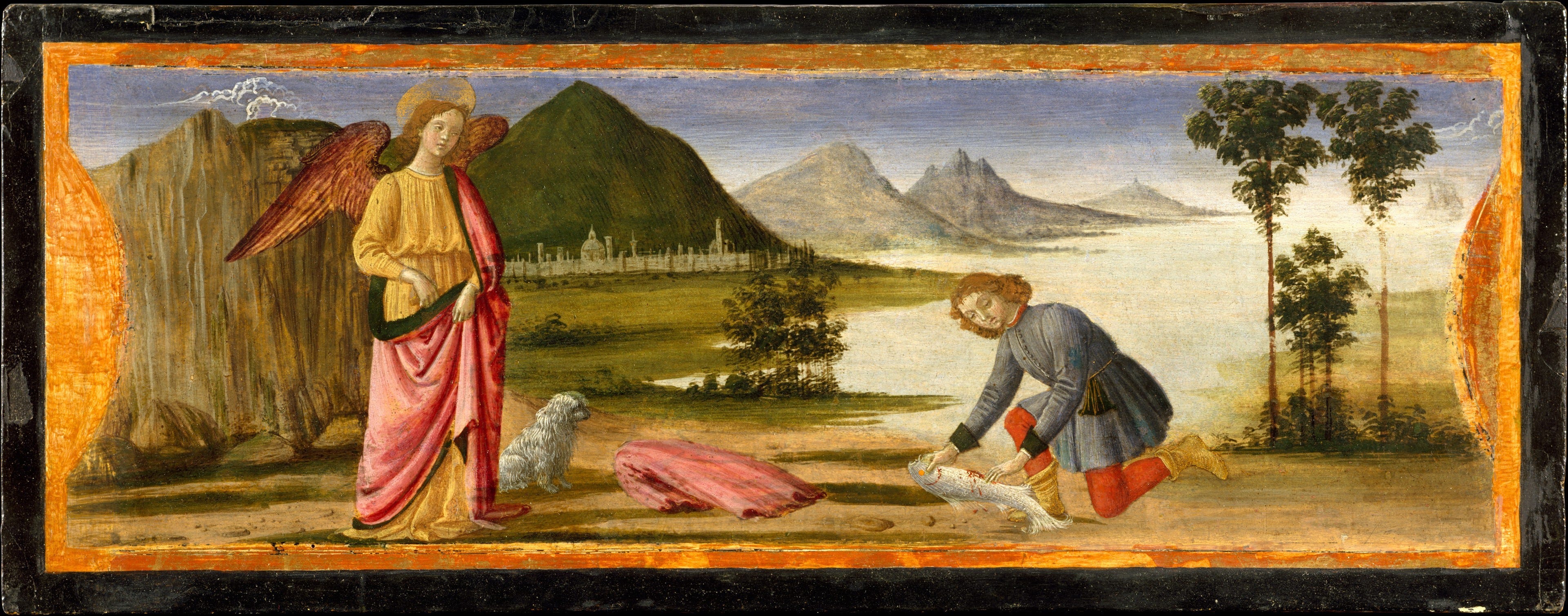
At the homecoming, the dog is once more mentioned in the same passage as the organs of the fish, which Raphael reminds Tobias of, for these must be given to Tobias’ father in order to heal him of his blindness.
Tobias is like Jacob here, who wondered for a time before returning home, where wondering generally anticipates Christ’s fast in the wilderness, and his father, Tobit, is like the blind, elderly Isaac. The restoration of the depleted father is a perennial theme. We may think of the grail knight restoring the maimed king Anfortas in the Holy Grail stories, where Anfortas is precisely described as “the fisher king,” and, of course, of the Son, Christ, redeeming humanity’s father, Adam, from the fall.
The cure is in the outside, in death (the chaotic waters; idolatrous nations; the Hades to which Christ descends after his crucifixion). By extracting the cure from chaos, chaos is defeated, transformed, abolished.
The presence of the dog throughout this process implies that the redemptive operation includes a domesticated animality, that is, the animal nature integrated into the human sphere. Nature itself is being transformed. It also implies that the agent of redemption (Tobias, Christ) will do his work in the company of loyal ministers (the “dogs of the Lord,” Domini Canes).
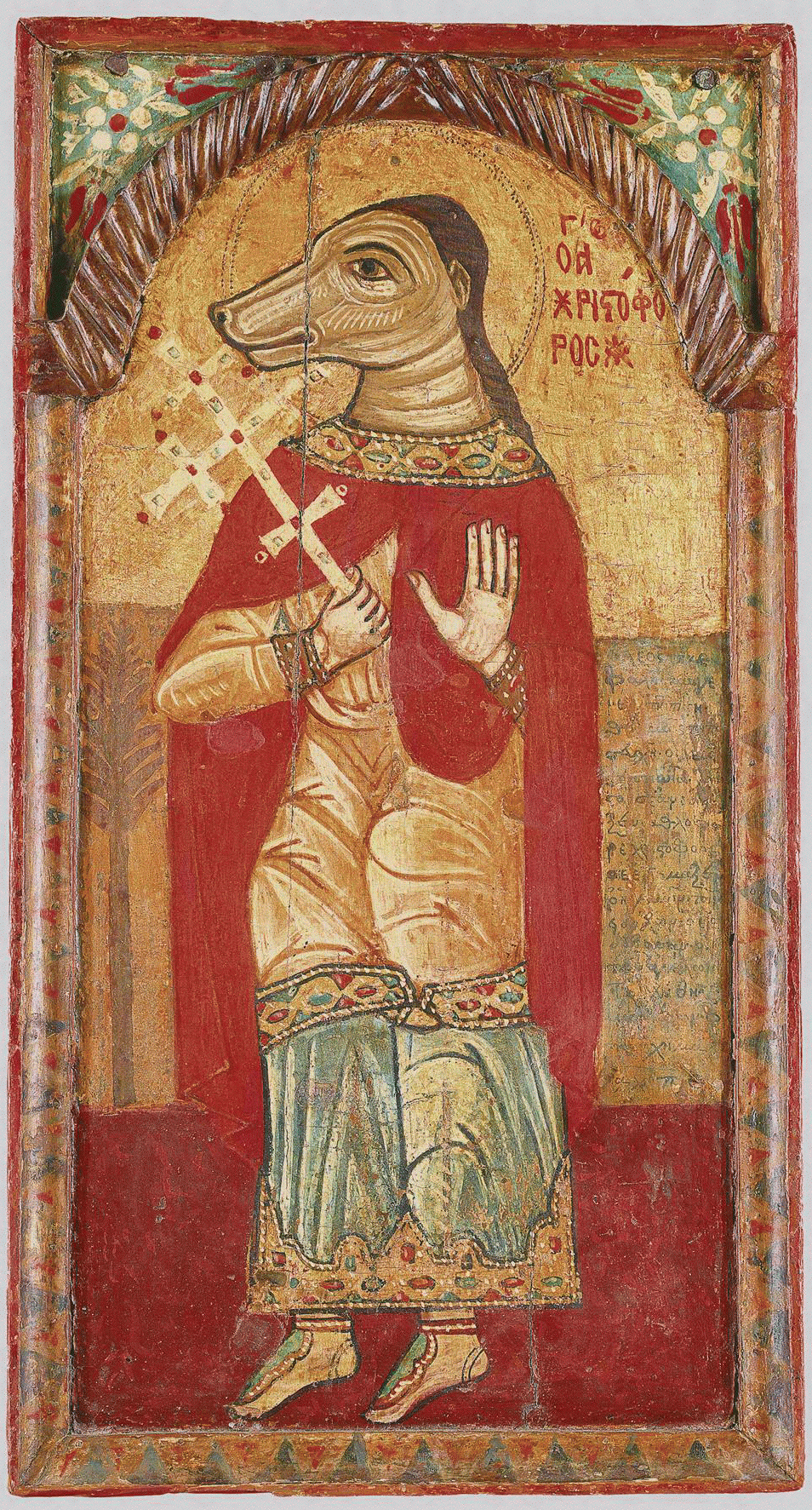
In terms of seeing the dog as a symbol for the transformation of wild nature into domestic nature, we should reflect on the story of the dog-headed saint, Christopher: he starts off as a brute wanting to serve whoever is strongest, but passes from being a knight in the court of Satan to the service of humble monks, after discovering that Satan fears Christ. St. Christopher’s helping the of the Christ child cross a river (per his story) would be equivalent to Elijah crossing a river in animal skins, or even Jacob wearing a hairy covering to impersonate his brother when approaching the bling Isaac: animality is being subjugated, “worn,” by the human, and so integrated and redeemed.
We may also think of the Canaanite woman Jesus encounters: her status as “dog,” which is at first demeaning, turns out to be a sign of humility and so, she is exalted (Matthew 15:21–28). The disciples are exalted through loyalty and humility, “dog” signifying both, having a positive as well as negative connotation in the Bible, including the passage just cited.
Participating in the work of redemption, like the dog who accompanies Tobias, the faithful are said to exert an angelic function (even to replace the angels in their administration of the cosmos). This brings us to a curious fact about the Book of Tobit: Tobit prays that God bring both his son Tobias and the angel Raphael (for he uses the plural of “you”) safely to their destination and back home. He specifically prays that God’s angel accompany them both (Tobit 5:17). The dog appears thereafter, being mentioned during the setting out and the returning back.
This reading, according to which Tobit’s prayer is answered by the presence of the dog, who would be an angel, delivers us unto the idea that
loyalty in accompanying the work of mankind’s redemption (restoring Tobit’s eyesight, raising Adam from Hades), and
being humble (embracing the lowly status of “dog”), entails an
exalted, “angelic,” status.
Hounds against Heresy
The world is full of devouring wolves, and you, unfaithful dog, know not how to bark.
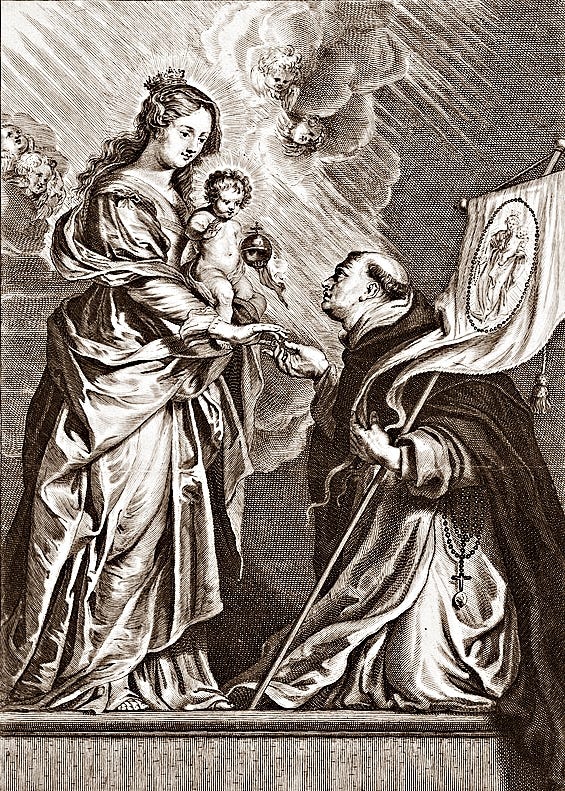
These are the words that have come down to us concerning the chastisement of one Blessed Alan de la Roche. Living during the 15th century, Alan was a Dominican priest from Bretagne living in Douai, near the English Channel. According to tradition, the Virgin Mary appeared to him, having previously been responsible for his conversion from a desultory life, and charged the priest with the task of reviving the practice of praying the holy Rosary.
Reluctant, whether disbelieving in the visions or fearful in some way, and perhaps on account of some excessive attachment to his studies and the works that had previously occupied him, Alan did not, at first, begin preaching the need to pray the Rosary.
As a consequence, following this, the Holy Mother returned to him, and with her the exalted spirit of the founder of his order, St. Dominic himself, to urge his spiritual son that he should take up that righteous commission which heaven had entrusted to him. And with these, the Lord, Christ himself was seen by Alan, and from the Saviour, the words above:
The world is full of devouring wolves, and you, unfaithful dog, know not how to bark.
Understandably, the Blessed Domenican now began to strive in the path set out before him. And dog he was. By way of Latin word play, the Domenicans are called “Domini canes,” the Lord’s dogs, hounds of heaven.
When its founder’s mother, Blessed Juana de Aza, was pregnant with the future saint, she dreamt that she would birth a dog, and it would carry a torch in its mouth, which it would carry throughout the world. The meaning of this dream would come to be known during the missionary labours of St. Domingo de Guzmán (1170-1221) and the members of the order he founded.
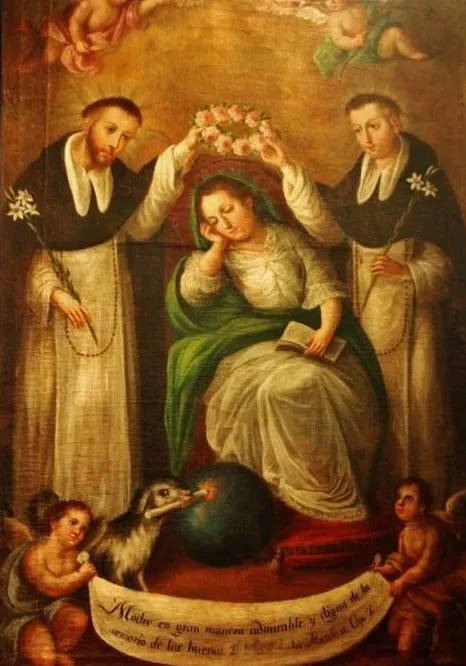
The torch as lampstand, burning with sacred oil, and its place in the hound’s mouth, as though fire and light were his bark, like a trumpet call, makes us think of the function of trumpets in the Bible, announcing and calling forth to battle, as against Jericho and the forces of the Dragon in the Apocalypse: Torches are sometimes accompanied by trumpets in the Bible (Judges 7:16-20) and appear in connection to weapons of war (Poverbs 26:18), keeping faith (Matthew 25) and the divine presence (Apocalypse 4:5). We also precisely find a scriptural connection with canines, as in Juana de Aza’s dream, when Samson used torches attached to foxes to wage war on the Philistines (Judges 15:3), which conflict is analogous to Dominican spiritual warfare. St. Dominic also championed the use of the Psalter of the Virgin, following a Marian apparition (but the history and function of the Rosary is a subject unto itself, and we are on the prowl for the metaphorical paw-tracks of canine symbolism).
Biblically, the wolf is a beastly devourer, one poised to consume sheep who stray from the fold of the blessed flock. This is the sense in which the presence of wolves throughout the world was invoked in the words heard by Blessed Alan from the mouth of his Redeemer.
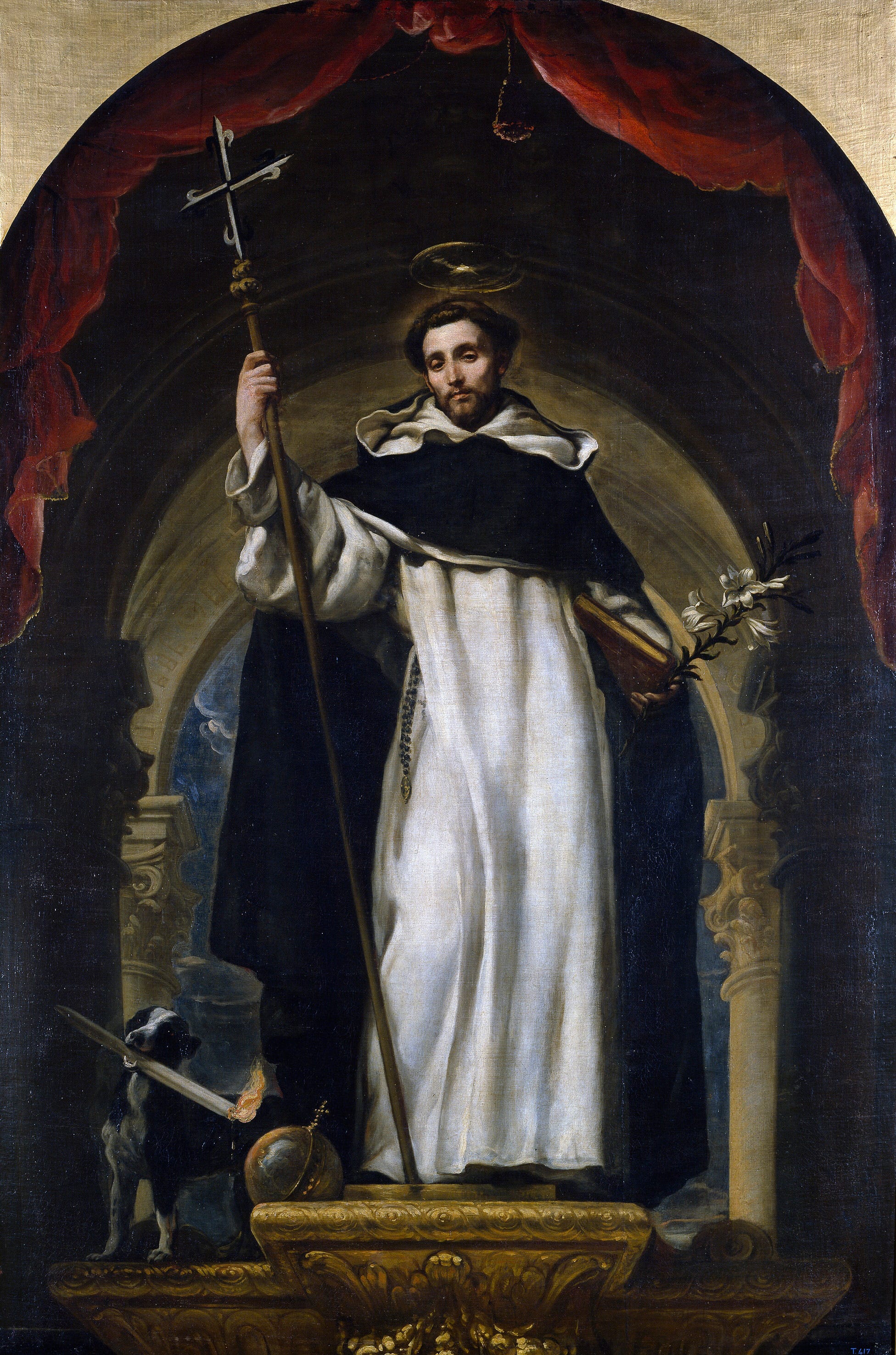
The dog, however, is a sheep in that flock. Not a wolf in sheep’s clothing, but a sheep turned wolf, a domestic wolf. Endowed with the predatory energies of that feral hunter, he places these are the service of the righteous assembly. Like St. Dominic, his lot is to warn (bark!) against heresy, to preach concerning the errors of the spiritual sickness of his era.
Dominic himself was locked in combat against the Albigensian, or Cathar, creed: an apparently dualistic system that seems to have posited the existence of two competing divinities, one of which, the creator of the material cosmos, had malevolently forged this world as an abode of abject slavery in which to entrap souls. The only hope for the latter is therefore to utterly reject and thereby escape this realm. A doctrine such as the resurrection of the body, then, would be quite anathemic to Catharism. Like the neo-Platonists and early Christians, Dominic’s generation was called to refute Gnosticism by expounding on materiality’s ultimate participation in higher metaphysical principles.
This would be the first “bark” of the heavenly hounds.
It would not always be wolves outside the shepherd’s pastures, however. The sheep are sent among the wolves, therefore the wolves are among the sheep—and so must the dogs be.
At various times, the church has suffered corruption, as have the centers of secular authority. The Whore of Babylon (Apocalypse 17) which is false religion, an unchaste bride fornicating with many idols, as the prophets describe Israel becoming (Isaiah 1:21, Ezekiel 16:30-34, Jeremiah 3:1-6), joins with the Beast that emerges from the sea, that is, political power when it has been seduced by the Dragon/Devil (Apocalypse 13).
Dante and the Dominicans
Now I want to turn to Dante’s Divine Comedy and other of the Florentine’s works, where the dog appears as righteous figure, drawing not only on Biblical and Dominican symbols, but on the Roman past, which he thereby integrates and transforms.
Born a few decades after St. Dominic, Dante Alighieri (1265-1321) would seem to invoke the image of the dog in such a context. He refers to St. Dominic in the Paradiso’s 12th Canto (through spirit of Franciscan St. Bonaventura):
The love that makes me fair
Draws me to speak about the other leader,
By whom so well is spoken here of mine.
The “other leader” is St. Dominic, whose followers have “spoken here of mine,” that is, have praised St. Francis, founder of Bonaventura’s order.
’Tis right, where one is, to bring in the other.
The idea that Dominic and Francis are somehow complementary is a consistent one in church history (these two orders are particularly connected to the Rosary devotion, in which context the apparition at Las Lajas is significant).
When the Emperor who reigneth evermore…
he to his Bride brought succour
Christ and his Bride, the Church
Within that region where the sweet west wind
Rises to open the new leaves, wherewith
Europe is seen to clothe herself afresh…
Is situate the fortunate Calahorra…
Therein was born the amorous paramour
Of Christian Faith, the athlete consecrate…
That in his mother her it made prophetic…
The woman, who for him had given assent,
Saw in a dream the admirable fruit
That issue would from him and from his heirs…
Dominic was he called; and him I speak of…
This refers to Joahn of Aza’s dream of the dog. We know, then, that Dante knew of the spiritual symbolism of the dog, by way of the Dominicans.
Hound against Whore
At the beginning of the Inferno we read of a hound who will defeat a she-wolf that seems to resemble the prostitute Dante depicts as falling to a messianic figure at the end of the Purgatorio.
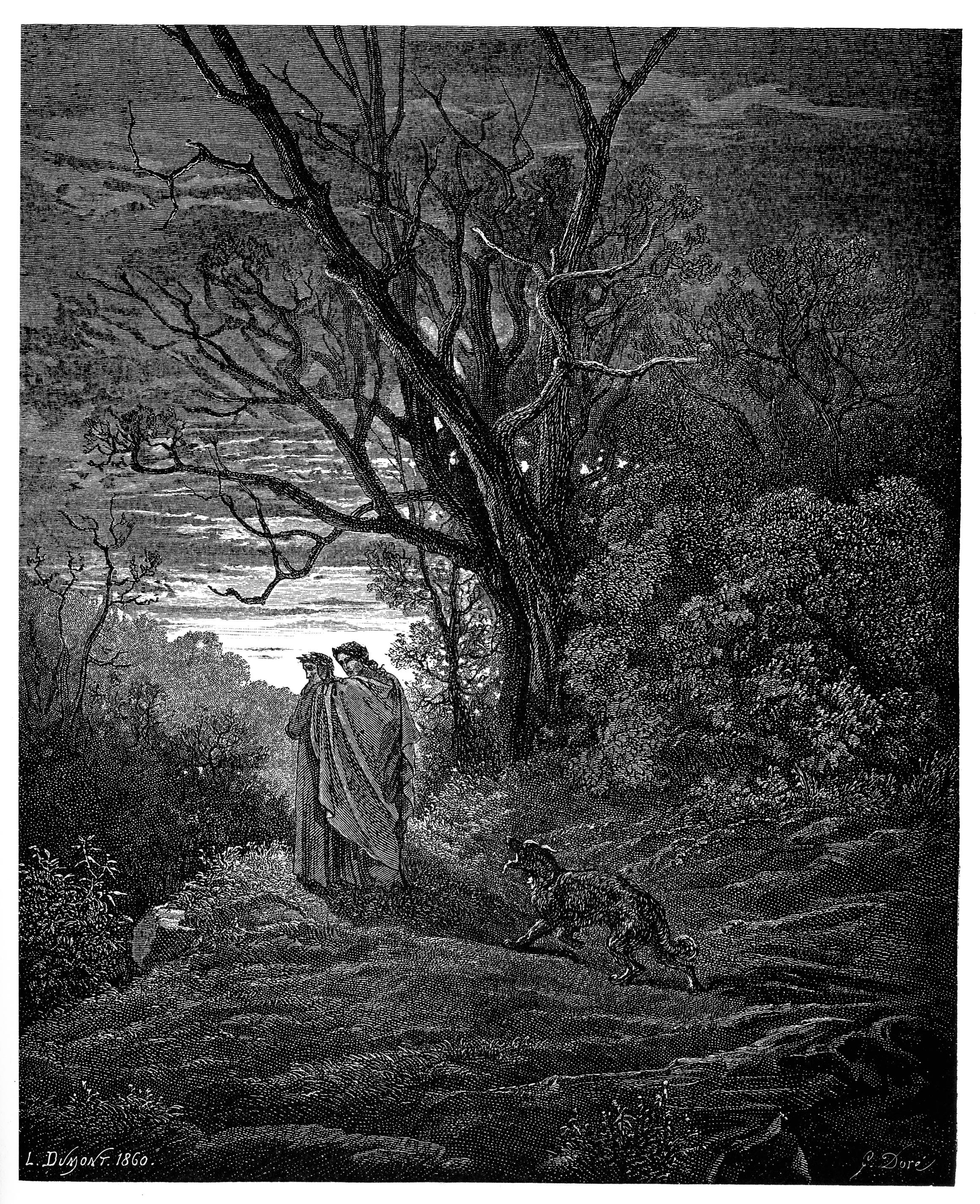
Says Dante to his guide, Virgil, in the first Canto of the Inferno (trans. Henry Wadsworth Longfellow):
And a she-wolf, that with all hungerings [avarice]
Seemed to be laden in her meagreness,
And many folk has caused to live forlorn!
…Behold the beast, for which I have turned back;
Do thou protect me from her, famous Sage,
For she doth make my veins and pulses tremble.
Whereupon the Roman poet answers,
Thee it behoves to take another road…
If from this savage place thou wouldst escape;
Because this beast, at which thou criest out,
Suffers not any one to pass her way,
But so doth harass him, that she destroys him;
And has a nature so malign and ruthless,
That never doth she glut her greedy will,
And after food is hungrier than before.
The beast in question is a she-wolf, a straightforward reference to Rome by way of the she-wolf said to have suckled Romulus and Remus. She is described in language consistent with the Biblical image of the Whore of Babylon:
Many the animals with whom she weds,
And more they shall be still…
This relates to the Roman use of “she-wolf,” lupa, as slang for prostitute (as Livy, Plutarch and Dionysius of Halicarnassus all report).
In the Bible, the Whore is a symbol of false religion, of the unfaithful Israel, and therefore the unfaithful church as spiritual Israel, which church is based in Rome. city of the she-wolf. Dante’s consistent attacks on certain Popes (prominently Boniface VIII) is consistent with identifying the Roman church as having fallen into spiritual whoredom and constituting a particular manifestation of the Biblical image in question.
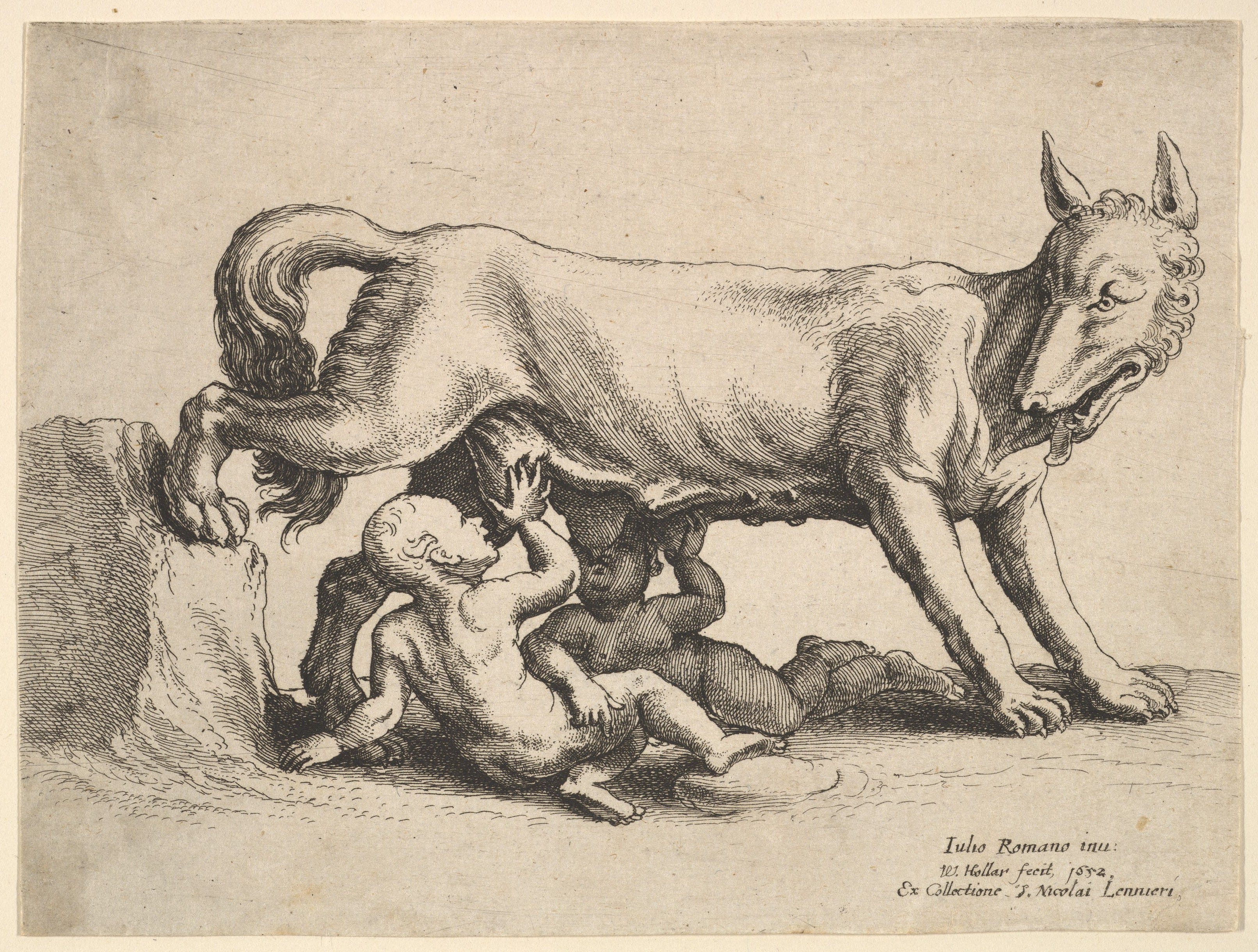
Just as, for Dante, the church is true and yet corrupted, the symbol of the she-wolf need not be wholly negative, rather, one of its meanings (that of prostitute) happened to be on display in the Florentine’s era. But he did not reject Romanitas, quite the contrary—indeed, it is Virgil himself who is leading him. Further, the she-wolf that mothered Romulus and Remus was precisely not avaricious: she did not consume the infants, but was well disposed towards humanity, like a dog (being a form of the goddess Rumina).
Interestingly, the fact that the title of the city’s mother (of she who suckled Rome’s founder and his brother) carried the negative connotation of prostitute provides a parallel to the two sets of images associated with—or rather, the two contradictory destinies open to—Israel (and specifically Jerusalem) in the Bible: those of Bride and Whore.
Taking up the Roman founding myth through its parallels with Biblical symbolism serves to integrate and transform it, just as the dog, as domestic wolf, is an integration and transformation of wild nature into the human sphere.
We may further connect the figure of the she-wolf to Rome by noting Dante’s reference to a lion and leopard, the other wild animals blocking his way at the beginning of the Inferno. Writes the prophet Jeremiah (5:6-8):
Wherefore a lion out of the forest shall slay them, and a wolf of the evenings shall spoil them, a leopard shall watch over their cities: every one that goeth out thence shall be torn in pieces: because their transgressions are many…
We find precisely the same animals here (lion, leopard and wolf), as well as imagery of promiscuity in religion:
When I had fed them to the full, they then committed adultery, and assembled themselves by troops in the harlots’ houses. They were as fed horses in the morning: every one neighed after his neighbour’s wife.
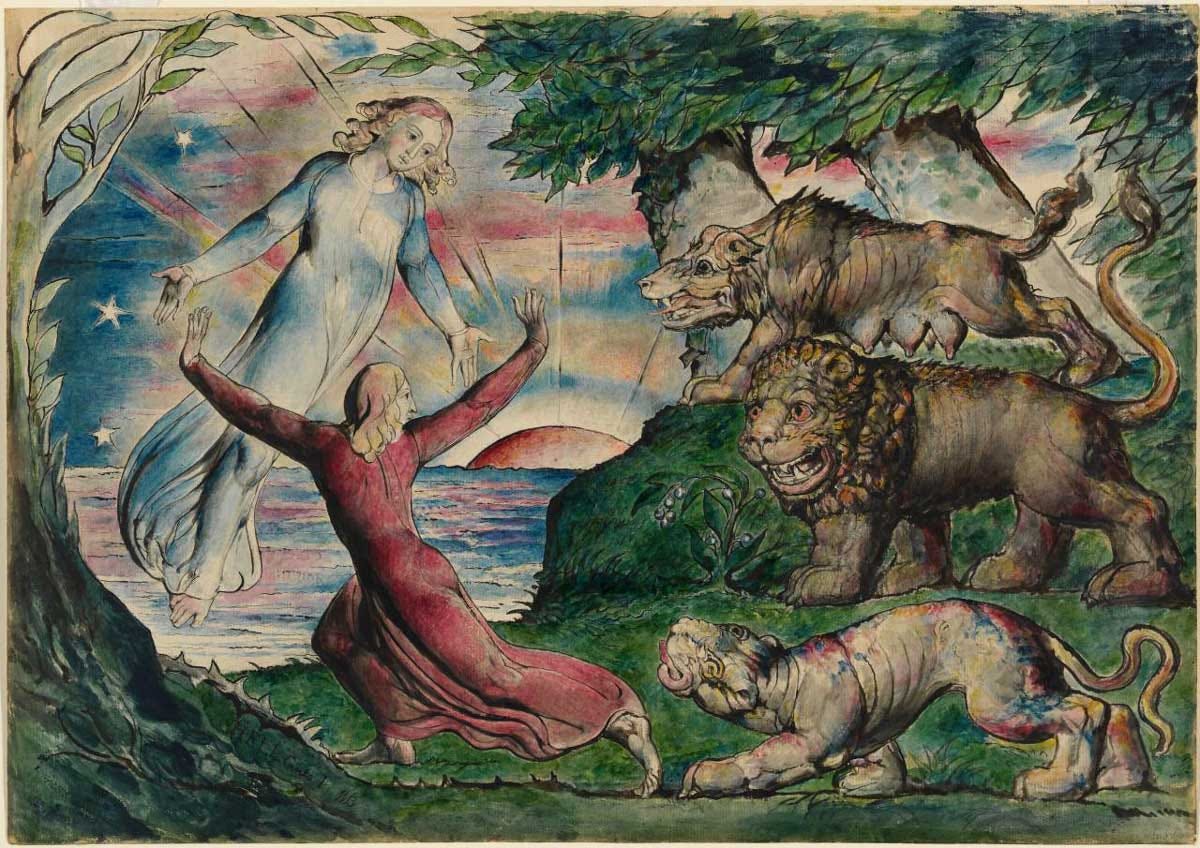
These images also partly appear in Daniel 7:4-6. The Prophet Daniel saw several beasts representing successive empires. In themselves these are not negative, for they can serve to guard Israel, having an angelic archetype (Ezekiel 1) and, even when turning against Israel, serve as the Lord’s corrective action (Hosea 13). The fourth beast Daniel sees, which John picks up in the Apocalypse, is most obviously a symbol for the Roman Empire as persecutor. It recapitulates the preceding beasts and completes the series, which is compatible with that interpretation of Dante’s lion and leopard as being the political allies of a corrupt papacy (specifically the French king at the time).
Things become explicit in the Paradiso. Dante speaks of Rahab, usually regarded as having been a prostitute, but redeemed, and so the opposite of the church that allows itself to be corrupted and becomes a prostitute:
Rahab…
First of Christ’s triumph was she taken up…
Even as a palm of the high victory
Which he acquired with one palm and the other [this refers to the crucifixion],
Because she favoured the first glorious deed
Of Joshua upon the Holy Land…
But the Papacy is of another mind,
That little stirs the memory of the Pope.
Dante now turns to Florence, which he condemns, writing that she
Brings forth and scatters the accursed flower
(the Lily on its golden florin, but perhaps also the flower of virginity), by which
both the sheep and lambs hath [been] led astray
Since it has turned the shepherd to a wolf.
The image of the shepherd, i.e. the Pope, becoming a wolf, connects Rome to the she-wolf once more, and the only a few verses later, we will find this image again connected to adultery.
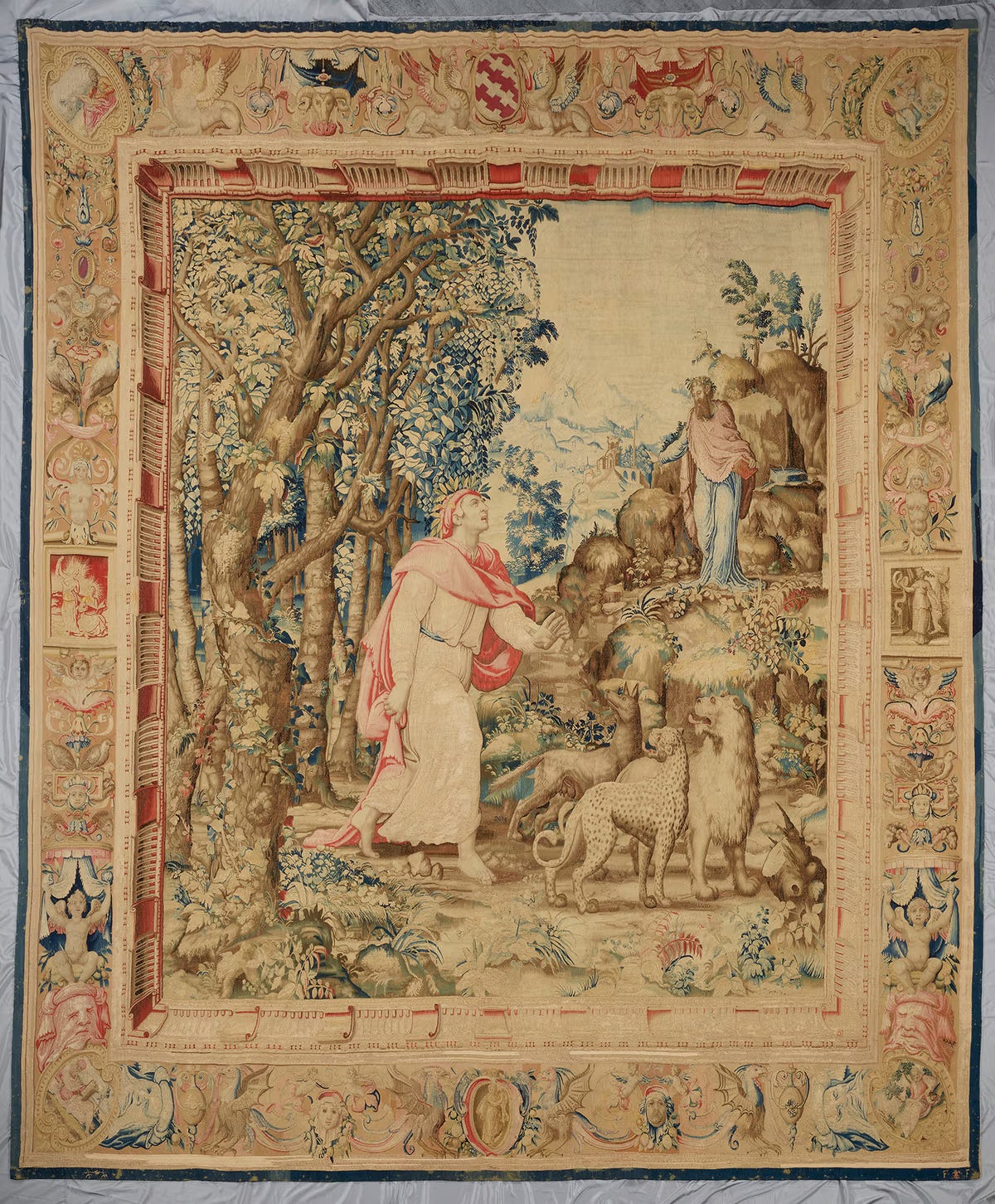
Dante is specifically referring to the abandonment of the study of religion proper, in favour of Ecclesial Law (which can be taken as a criticism of those who assembled the Decretals, Popes Gregory IX and Boniface VII):
For this the Evangel and the mighty Doctors
Are derelict, and only the Decretals
So studied that it shows upon their margins.
On this are Pope and Cardinals intent…
Popes and cardinals prefer that the Decretals be studied, rather than the Evangel (Gospel). The trajectory of Dante’s critique and of the work of his prophesied Hound is towards scholarly engagement with foundational texts and contemplation of core spiritual principles, and a corresponding suspicion of “Decretals” and historically accruing teachings. Of the ecclesial authorities favouring the former, he writes:
Their meditations reach not Nazareth,
There where his pinions Gabriel unfolded
But Vatican and the other parts elect
Of Rome, which have a cemetery been
Unto the soldiery that followed Peter
Shall soon be free from this adultery.
Here, the conduct of the church is described as adultery. Thus, in the Inferno, Rome’s demonic image presents as a mixture of the Biblical Whore and the Beast, two separate figures. To this we should add the general meaning of “wolf” in the Gospel as forces seeking to devour the faithful. This plain meaning is used in Canto 25 and 27 of the Paradiso
From the fair sheepfold, where a lamb I slumbered,
An enemy to the wolves that war upon it,
and
In garb of shepherds the rapacious wolves
Are seen from here above o’er all the pastures!
O wrath of God, why dost thou slumber still?
Indeed, when we come to the circle of hell reserved for the avaricious, and recalling that the she-wolf was described as given over to avarice, Virgil addresses the jailer of that realm as an “accursed wolf,” when the latter calls out “Pape Satan, Pape Satan,” apparently to warn the Devil of the presence of righteous souls. The “accursed wolf” is thus a loyal dog to the devil, and his bark a parody of the bark with which the righteous are to warn each other.
The Dog, the DVX
Speaking of righteous dogs, and returning to Canto 1, Virgil prophesizes that the she-wolf will fall to a certain dog-saviour:
until the Greyhound
Comes, who shall make her perish in her pain.
He shall not feed on either earth or pelf,
But upon wisdom, and on love and virtue…
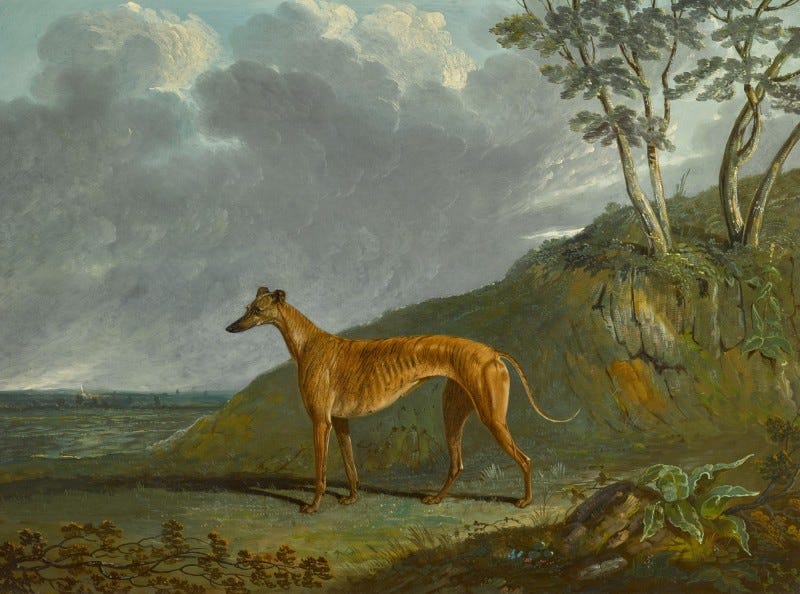
Just as we noted earlier, and as Blessed Alan reports, the safeguard against the wolf is the hound. It is a domestic, loyal, version of the wolf that will defeat her. We have here a fellow canine, like a son of the she-wolf, whereas she is an image of the false mother (the mother church grown sinful, wild like a wolf). The idea of dogs becoming wolves appears in Canto 14 of the Purgatorio, referring to the Florentines and so, to the corruption of peoples,
…the dogs becoming wolves,
This maledict and misadventurous ditch...
Thy grandson I behold, who doth become
A hunter of those wolves…
The dog breed usually translated as Greyhound is veltro in Italian (plural veltri).
When Dante refers to veltri, it is usually in terms of their speed (Inferno XIII, 125; and Il Convivio I, xii, 8; Rime LXI, 3; Rime CIV, 102). In the Inferno, two suicides are pursued by dogs like veltri, and in Il Convivio, we read that virtues proper to a thing are estimable in it, like speed in a veltro. The figure who will defeat the she-wolf, then, will do it swiftly, decisively.
In defeating the she-wolf, this Greyhound will succeed in lifting up Italy,
‘Twixt Feltro and Feltro shall his nation be;
Of that low Italy shall he be the saviour,
On whose account the maid Camilla died,
Euryalus, Turnus, Nisus, of their wounds;
Through every city shall he hunt her down,
Until he shall have driven her back to Hell,
There from whence envy first did let her loose.
The figure of the Greyhound has been connected to specific historical personages (prominently the “Can Grande della Scala, Lord of Verona, Imperial Vicar, Ghibelline, and friend of Dante” and Emperor Henry VII of Luxembourg).
Indeed, “Can Grance,” whose name means large dog, would have been born between Feltre and Montefeltro (“’Twixt Feltro and Feltro”). Another school of interpretation points to feltro as a modest cloth, cheaper than wool or silk, indicating a monk or person of humble birth, although others have argued the opposite, given that felt can be used to cover expensive carpets and the like.
The fact that felt might connect poor garments to expensive ones serves precisely to emphasize the royal, ennobling character of humility. At that time, felt consisted of cheap animal fur, which links it to the lowly, yet exalted, dog (and in general to the theme of spiritual royalty resulting from slaying and integrating, wearing, the animal self.) Still others have used the assonance of cane with “Khan” to argue that this prophecy refers to a righteous, eastern monarch (which interpretation Boccaccio, for his part, reports and rejects).
Theology professor Ernest L. Fortin has suggested that what is between “feltro and feltro” is Dante’s book itself, or at least a book:
Fortin’s suggestion is eminently plausible when one considers the place of felt in the process of making books in the Middle Ages…For several centuries, beginning in the late thirteenth and into the early nineteenth, felt was employed in the manufacture of paper throughout Europe.
The book is made of felt because the material is cheap, but the words written on it elevate it, even as holy scripture can be written on humble paper: again, this relates to the ambiguity of felt as a poor man’s garment also used to cover precious materials.
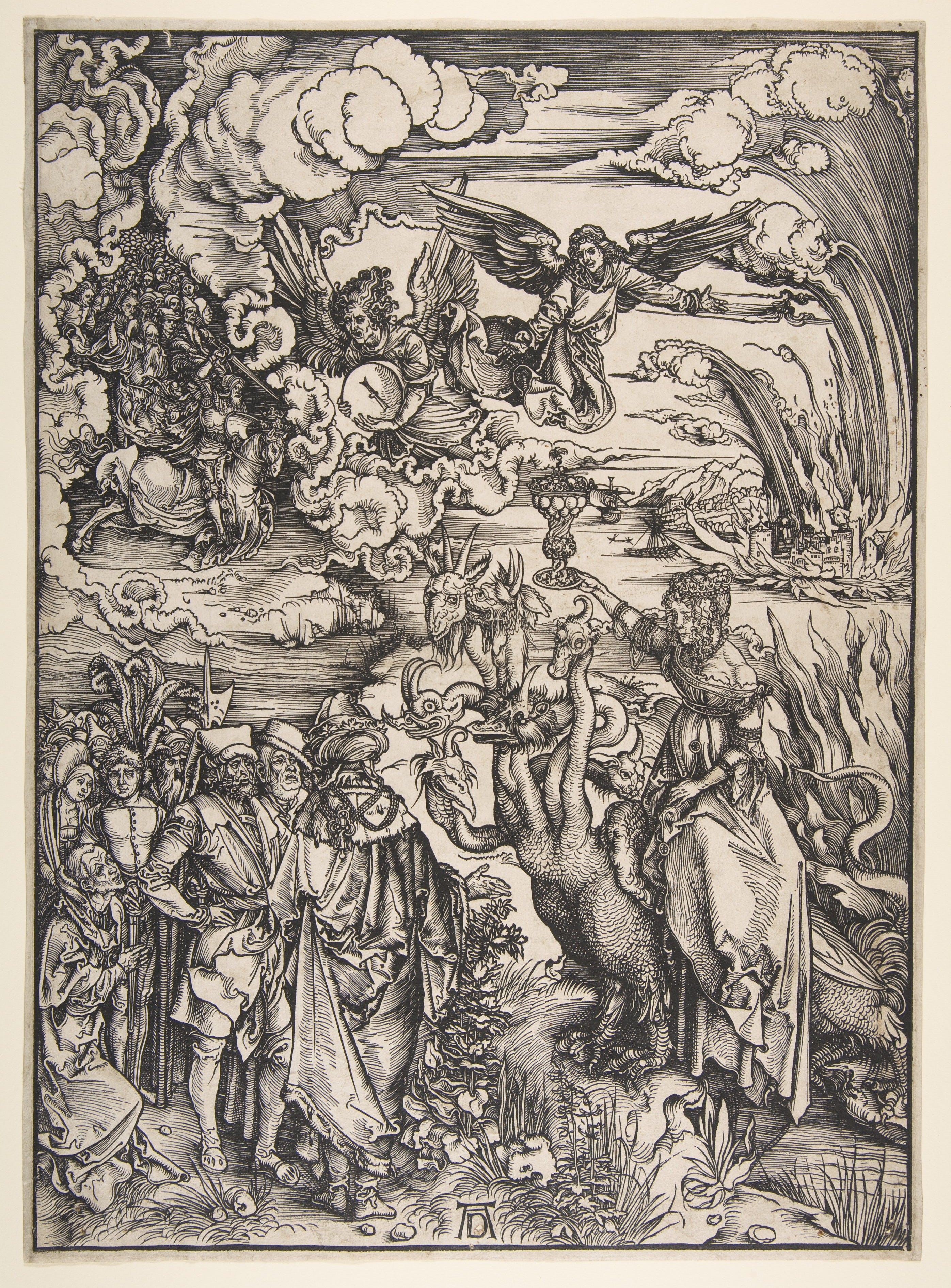
In Canto 33 of the Purgatorio, we encounter the Whore and the Beast and are told that
Within which a Five-hundred, Ten, and Five,
One sent from God, shall slay the thievish woman
And that same giant who is sinning with her.
Commentators will often remark that the number 515 can be rendered in Roman numerals as DXV. Taking the X to represent the cross, this mysterious word can be understood as the joining of God and man, with the “D” standing for Dio and the “V” for Uomo, “X” being the mediator. DVX is also nearly “Dux,” meaning leader. In addition, if the letter order is reversed, DXV can also indicate a prayer, with V and D standing for Vere and Dignum, the words that preface the (traditional Latin) Mass.
The she-wolf of the Inferno is, in the Purgatorio, differentiated into a Whore and Giant (apostate Church and apostate Holy Roman Empire or kingdoms). Since giants in the Bible are born from illegitimate consorting of human women with fallen angels, we might identify the Giant as a product of the Whore: the church serving to legitimize corrupt secular authority. Dante has transitioned from the symbolism of Jeremiah to that of John’s Apocalypse.
The Greyhound, likewise, appears here as a messianic figure, a manifestation in history of the Christological proceeding. He is the true faith, God (D) united to Man (V) through the Cross (X). Here, too, Dante is using techniques consistent with the Apocalypse, so rich in numerical symbolism, which suggests he is making a point concerning the patterns we read of in that final book of the Bible. Crucially, the fact that the Greyhound of the Inferno is now connected to the DVX figure of Purgatorio relates to St. Domenic, whose preaching was against dualism (those who would deny the harmony of D and V through X). The Greyhound, then, would be a champion for religious truth. This takes us back to Dante’s praising of the Dominicans (and Franciscans), known for attacking false doctrine (specifically the Dominican’s foundational struggle against dualism, against the gnostic rejection of materiality).
I don’t mean that this constituted a defence of explicit catholic dogma in toto, which Dante contradicts on a few points—the Greyhound and DXV are rather a bulwark of the fundamental insight of spiritual conjunction (X) between God (D) and humanity (V), as opposed to dualistic understandings. Indeed, the DXV prophecy of a coming European prophetic figure and restorer (to which, among others, we may add certain of Merlin’s utterances in Geoffrey of Monmouth) implies a thorough corruption of the religion in its exoteric doctrine and practice, and a straying from the Roman mission. Dante’s explicit commitments (the politics of De Monarchia for example, whose arguments are generally weak) are less interesting than his deeper intuitions.
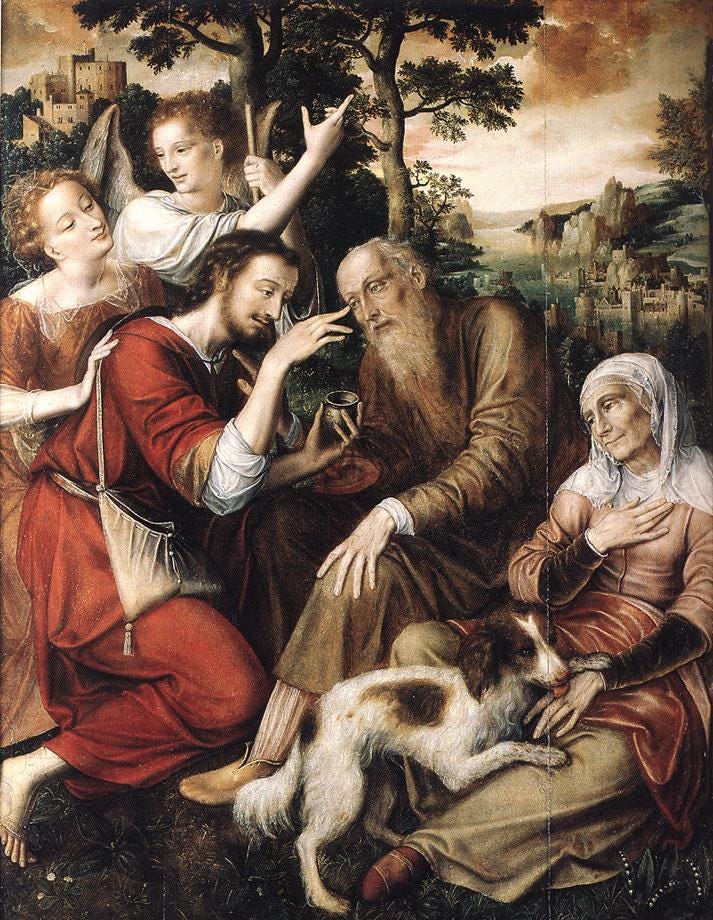
The above also brings us full circle, back to the Book of Tobit, where a loyal dog accompanies Tobias in his journey, whereupon the son gains medicine to cure his father’s blindness. The spiritual blindness that denies relationship between transcendence and imminence, or God and man, is what is being healed in Dante’s prophecy. The fact that it is proclaimed by Virgil, the Roman pagan, means that the pagan sphere has been redeemed, the assailing fish from chaotic waters which Tobias must contend with has been defeated, yielding up a cure for blindness. For Dante, the gentile Italian, his father, the pagan past (represented by Virgil), has been healed, his spiritual blindness has ended. The past is retroactively converted. Tobias and his angelic dog have restored Tobit, Christ has redeemed Adam.
What a great post. Oh how we could do with Domini canes, tearing apart the wolves of today.