



The Mystery of the Filly Loo
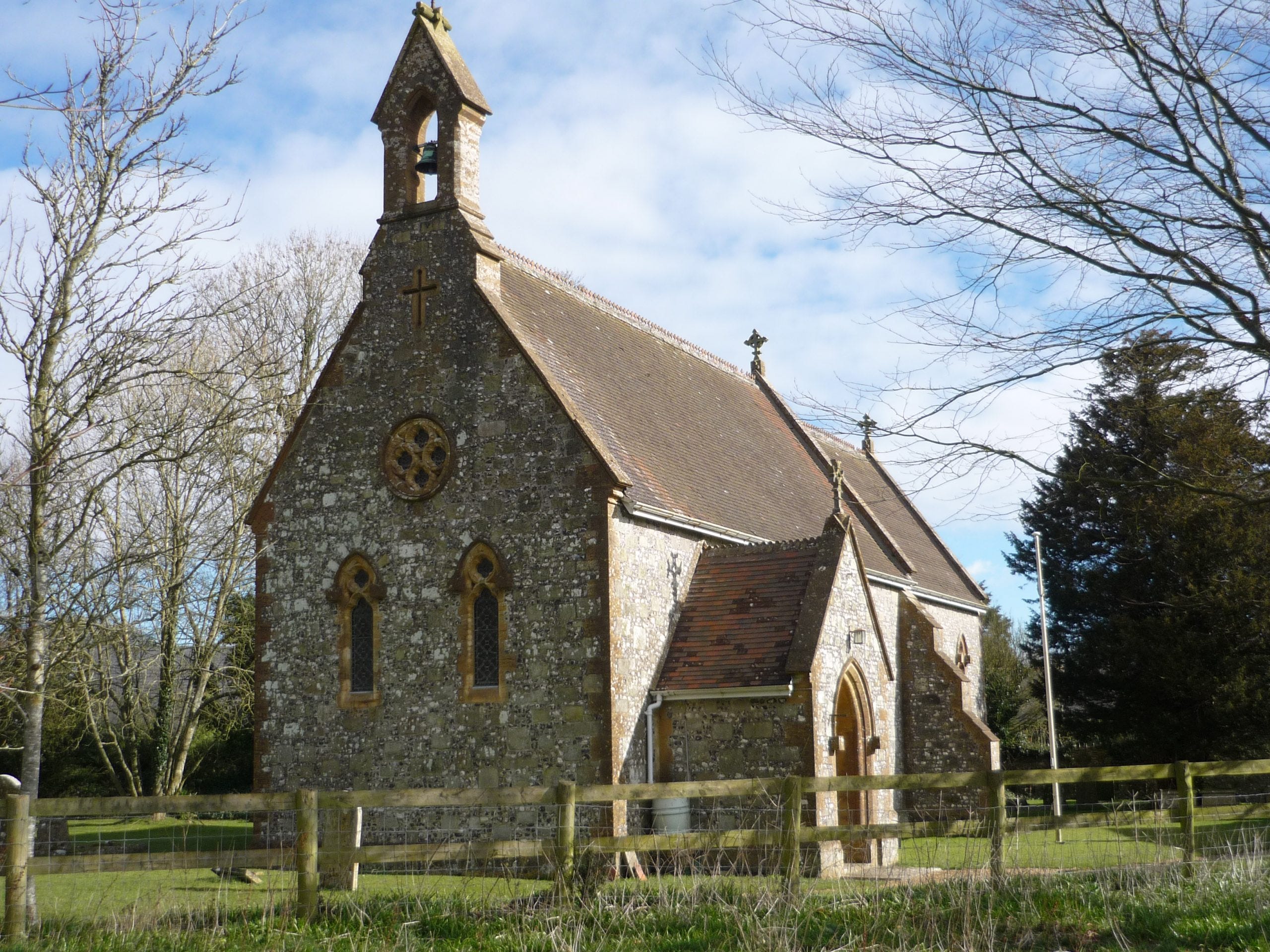
Apparently, no one knows where the name comes from. The ‘Filly Loo’ has however taken place on the Friday closest to the Summer Solstice every year for centuries. On the day, hundreds of people from surrounding settlements descend on the tiny village of Ashmore in Dorset, which incidentally is believed by some to be the oldest continuously inhabited village in Britain, possibly settled sometime during the Roman occupation two millennia ago. Ashmore now consists of a population of 170 people living among a few cottages and houses, a medieval church, and some farms, all scattered around a large dew pond in the centre, inhabited by some well-fed ducks.
Some folk speculate that the name ‘Filly Loo’ comes from a lost local dialect, and they make an educated guess based on other dialects of the West Country that it meant ‘uproar’ or ‘celebration’. Others, perhaps more convincingly, say that it’s a corruption of ‘Filbert Louis’, the nickname of a local gentleman called Louis Rideout who was especially zealous in keeping the festival going at times when it faced suppression. Still others suggest it could derive from the French “La Fille de l’Eau” (‘the maiden of the water’), referring to local lore concerning a water sprite who is believed to dwell in the dew pond, with the festival being thrown in her honour to keep her happy. This last theory may be the most credible, given that villagers to this day claim that on certain mornings a water nymph’s ghostly appearance can be spotted above the pond.
How old the Filly Loo is, remains unknown. There are medieval records alluding to the festival, specifically to the climactic dance—the Horn Dance—which proves that the Filly Loo is at least 700 years old. The festival is believed, however, to be far older, and may even be pre-Christian. Perhaps it was an annual harvest celebration that was ‘baptised’ during the evangelisation of these Isles and consequently connected in the local imagination with the veneration of John the Baptist, the animal-hide covered, insect-eating wild saint and cousin of the Lord.
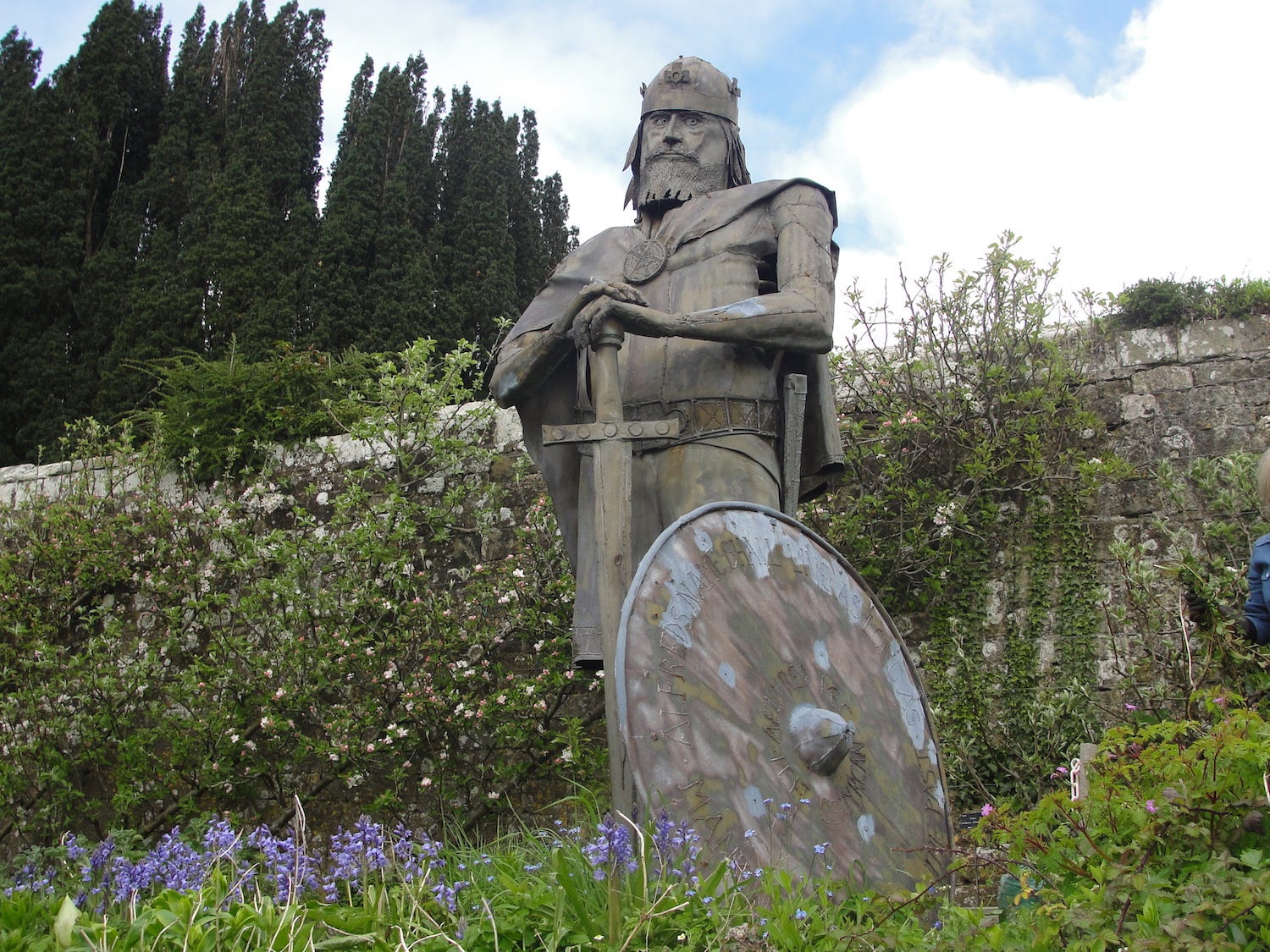
The Filly Loo could thus predate the arrival of Augustine’s mission in 597 AD, and maybe was encountered by Roman missionaries as they travelled west or Celtic missionaries as they travelled East. It may have been attended by St Wite, Dorset’s patron saint, whose relics remain untouched by the Reformation in an ancient casket near the Jurassic coast, or perhaps by King Alfred who resided at Shaftesbury, a nearby town where Alfred’s daughter was Mother Abbess of the Abbey of St Mary—a vast religious house behind the castle where Alfred planned to make his last stand if the Danelaw pushed south to crush embryonic England.
At numerous moments in history the Filly Loo has ceased, but never for long, for it was always revived by the villagers of Ashmore at the first opportunity. Notably, it disappeared during the Commonwealth of Oliver Cromwell. This was probably when he was sending Roundhead soldiers to the West Country to threaten with violence anyone who practised wassailing (the ancient custom—still very much alive—of singing to orchards to protect the trees from evil spirits and guarantee decent cider from the apples), or beat up those who celebrated the May Day festivals or any of the other folk traditions of which the Puritans were deeply suspicious. Interestingly, records show that Cromwellian denunciations of such things deployed the words ‘Popish’ and ‘heathen’ synonymously, probably because Puritans intuited that all such things (many of which did and do have pagan origins) had been seamlessly accommodated by Catholicism’s sacramental view of the cosmos, a view of creation that the rising Protestant sects entirely rejected.
Waking the Green Man
My family and I arrived at Ashmore in the late afternoon, and as we approached in our car, a couple of farmers directed us into a large pasture field where vehicles could be left. We walked awhile until we arrived at the pond in the centre of the village. A couple of hundred people had already arrived. Several locals were cooking sausages and burgers over an arrangement of barbeques, local breweries and cideries had set up tents and almost everyone seemed to have a pint in hand. Some people had brought herbs and vegetables from their gardens to sell, from others handmade clothes and bags could be purchased, and an old lady stood at a table stacked with homemade cakes.
A large wooden 19th century farming wagon stood in the middle of the road, on which were assembled a folk septet playing and singing old folk songs from Dorset and other West Country shires. At one point the band’s lead introduced the next song, saying with a perfectly straight face, “The next piece is a song I picked up as a young man whilst wandering in the East”. It turned out to be a folksong from Wiltshire.
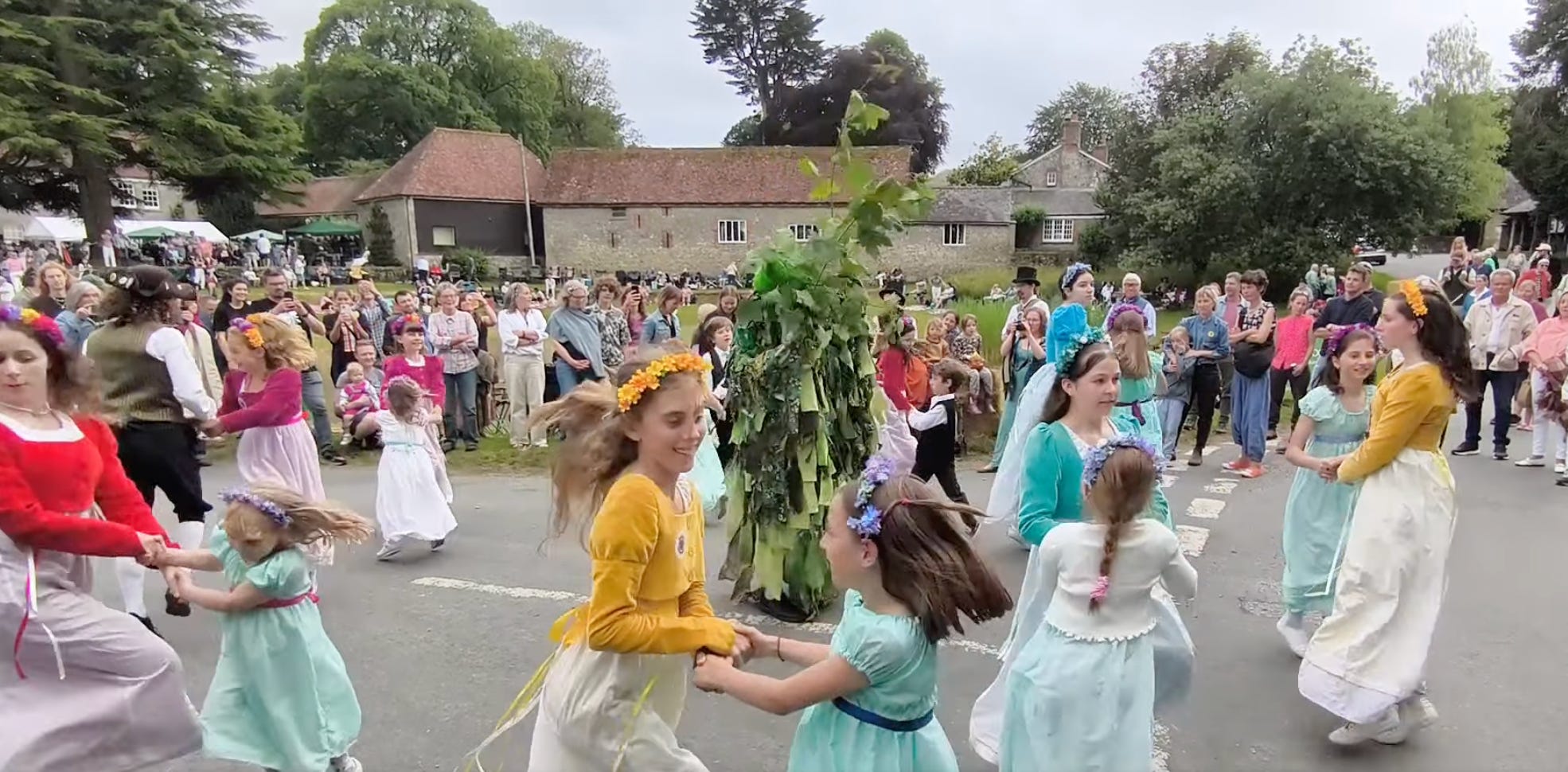
The event didn’t officially begin until the arrival of the Green Man. He appeared, covered in leaves and branches over long green strips of fabric, and silently he stood in our midst. The band began to play, and a group of children gathered around him and danced, intermittently charging up to him and shouting “Filly Loo!”, at which he would shake and shudder. On the tenth time of being roused from his slumber, the Green Man jumped into the air and then ran around the village as all the children chased him. With the Green Man awake, Nature had symbolically emerged from its wintertime dormition, and now was the time of colour and joy. The Filly Loo had officially begun.
Two large Morris sides competed, with one side focusing on the refined Cotswold Morris and the other on the boisterous Border Morris. People sat on the grass around the pond, listening to the music and watching the dancing. There are few things that please me as much as Morris dancing. The Cotswold Morris style reflects the gentle agrarian life of that region. The Border Morris, with its aggressive movements, stick-clashing, stomping, and yelling, reflects the turbulent relationship of England and Wales from whose border it derives its name, and the painted faces of the dancers—intended as a disguise, so that the dances could be performed as a way of begging without bringing shame on the families of those dancing—indicate the terrible economic challenges of that region down the ages. The almost mechanical Molly Morris style from the Fens reflects the determination of that region’s people and their complex struggle with industrialisation down the centuries. Almost every culture in the world has a sword dance of some kind in its folk tradition, and the English are no different, with their longsword and rapper-sword Morris dances (though admittedly we’re unique in not celebrating such things, and often even mocking them). Each style and each dance is thus a treasury of ancestral knowledge and experience, expressed theatrically and re-lived communally through the artistic endeavour.
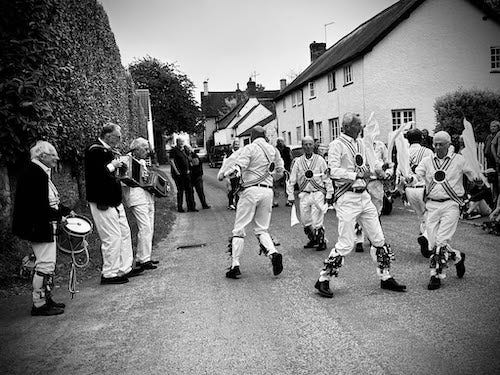
The Filly Loo attracted a wonderful selection of West Country life that evening. Local farmers in tattersall shirts drank cider alongside gentlemen in herringbone Nehru gilets, families with young children danced to the music with hippies who’d journeyed from Glastonbury. A caller moved about describing the next dance, and an ever-growing number of people joined the twirling between the band and the booze tents. The joy and laughter intensified through the evening and at some point it occurred to me that I had found myself in possibly the closest real event to Bilbo’s eleventy-first birthday party.
As nightfall approached, all went quiet. The caller ascended the stage of the wooden wagon whereon the band had been playing and asked the crowd for silence. “Now is the moment”, she announced, “please turn off your mobile phones, take no photographs or videos, and be as quiet as possible; this is the moment to do nothing but enter the magic of what is about to happen; I invite you to enter the magic of the Filly Loo”.
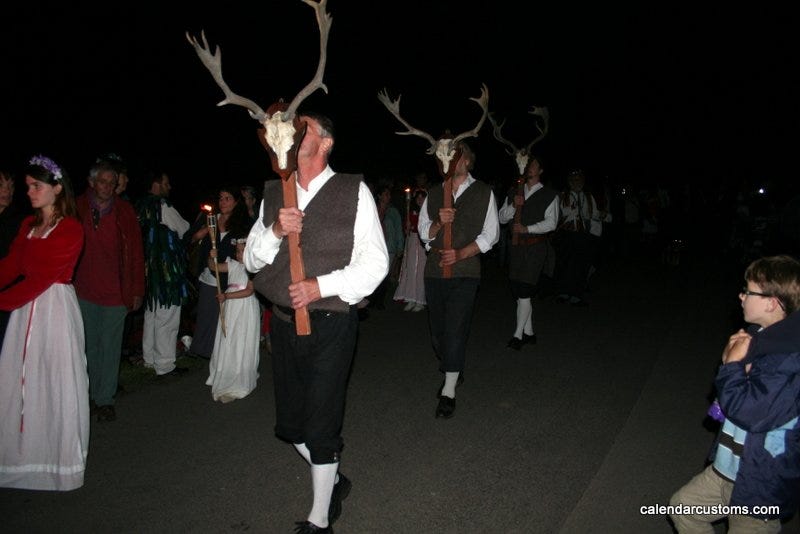
We—a few hundred of us—stood in perfect muteness. Flaming torches appeared atop the various streets of the village that wound towards the pond. It was children, processing down from all directions to Ashmore’s centre, holding above their heads flames that alone now illumined the village. Slowly walking with the torchbearers was a drummer and a fiddler, who together played the ancient and eery tune of the Filly Loo. And behind them came the Horn Dancers: six antlered men danced slowly towards the village centre until they arrived in front of the wagon; they were followed by characters of the deep English imagination: a Wizard, a Harlequin (or Fool), a Saracen on a hobby horse, and Robin Hood. There in our midst, accompanied by these avatars of English eccentricity, the Horn Dancers performed what I can only describe as a stylised stags’ rut, while the captivated audience—who had hitherto been cast into much fun and laughter—remained motionless and entranced.
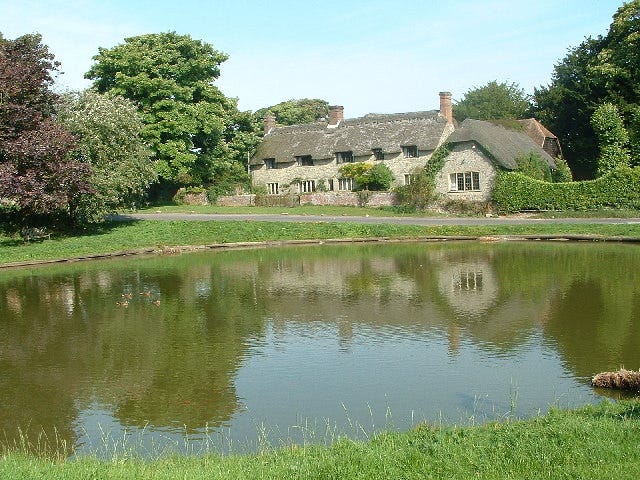
As the mystical dance came to an end, the torchbearers processed around the pond and planted their flaming lamps equally spaced apart around the water, and all present joined hands and sung Auld Lang Syne, as the British peoples are wont to do when they don’t know how else to conclude an evening. And as that final song finished, without further ado, all departed to their vehicles. By midnight, the little ancient village of Ashmore was wrapped in dark and silent tranquillity.
The Magic of the Divine Imagination
Driving in the twilight back from the Filly loo through the winding arboreal tunnels of Dorsetshire, it seemed that the enchantment of the event had settled upon the landscape. The woodland silhouettes appeared to tremble against the moonlight with the power of what had occurred that evening. As I drove, I recalled something I’d read earlier that day, a passage from the last work of the English writer Stratford Caldecott, entitled The Radiance of Being, wherein he reflects on the thought of the German mystic Jacob Boehme:
To create the world, according to Boehme, was an act of divine freedom motivated by love alone. The word he uses is ‘Magic’, referring to an outbirth of God’s eternal nature formed by the divine Will through the divine Imagination.
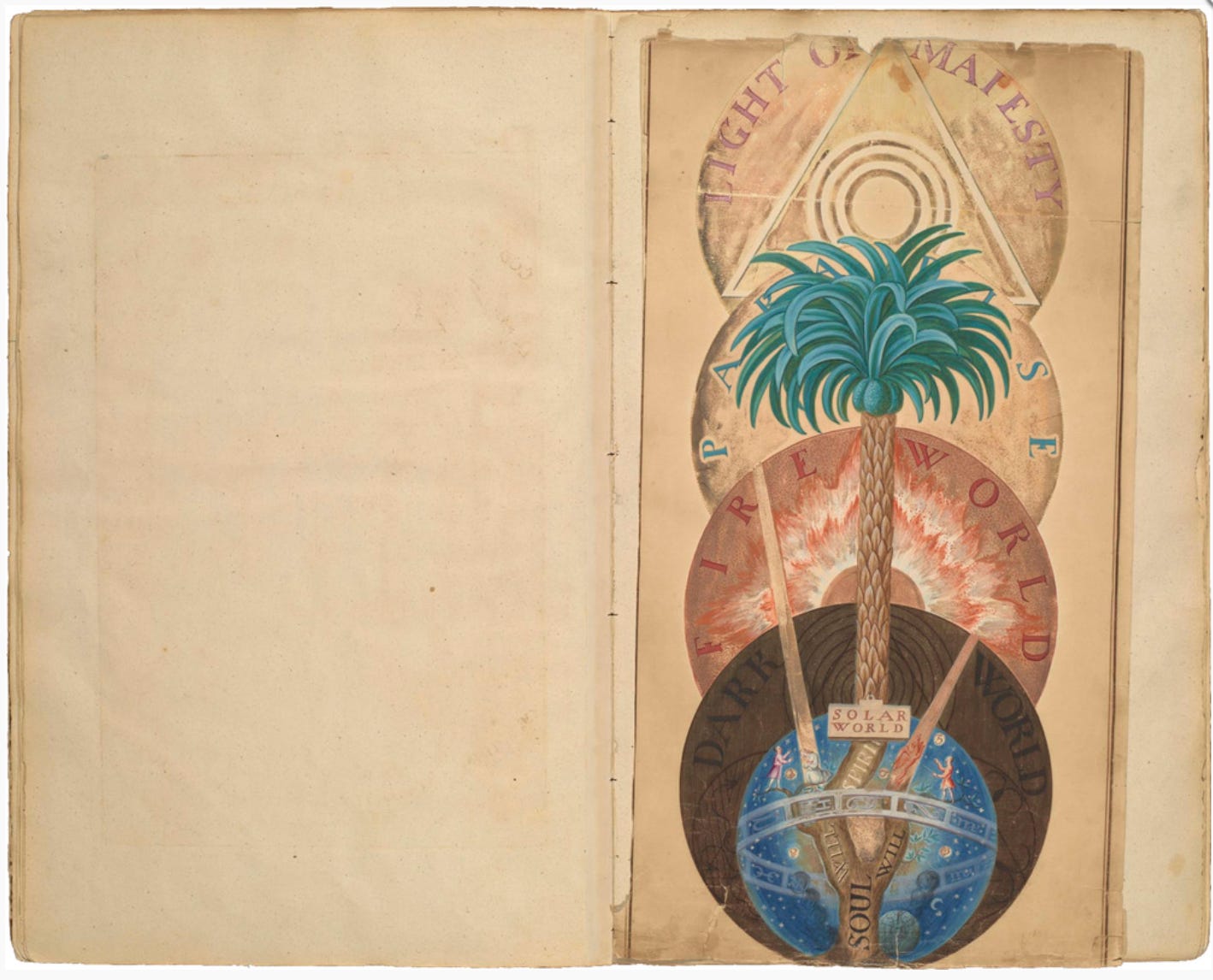
Such a view of the created order is very far from that endorsed by Martin Luther. But the philosopher Wolfgang Smith, who had an especial interest in Boehme, asserted that this unique thinker who had combined the life of a religious seer and with that of a cobbler, and whose life straddled the 16th and 17th centuries, was a Lutheran only due to an accident of geography. Had Boehme been born in a Catholic part of Mitteleuropa, he likely would have made a great Franciscan mystic of the Third Order tradition—though with his temperament and character, he probably still would have had some run-ins with the Inquisition.
In any case, Boehme was an emanationist, but not in the sense of negating divine freedom. As Caldecott comments, for Boehme creation was an act of divine freedom motivated by divine love. Another way to say this is that, from all eternity, God conceived of the cosmos in His divine mind, and beholding it there, He loved it, and hence willed that it be. Born from God’s own inner life, the cosmos unfolded out of the divine mind by an act of the divine heart, a single-eternal act which Caldecott is content to call a work of ‘divine Imagination’ (and no doubt he enjoyed watching his Oxfordian colleagues at Blackfriars wince at such a phrase).
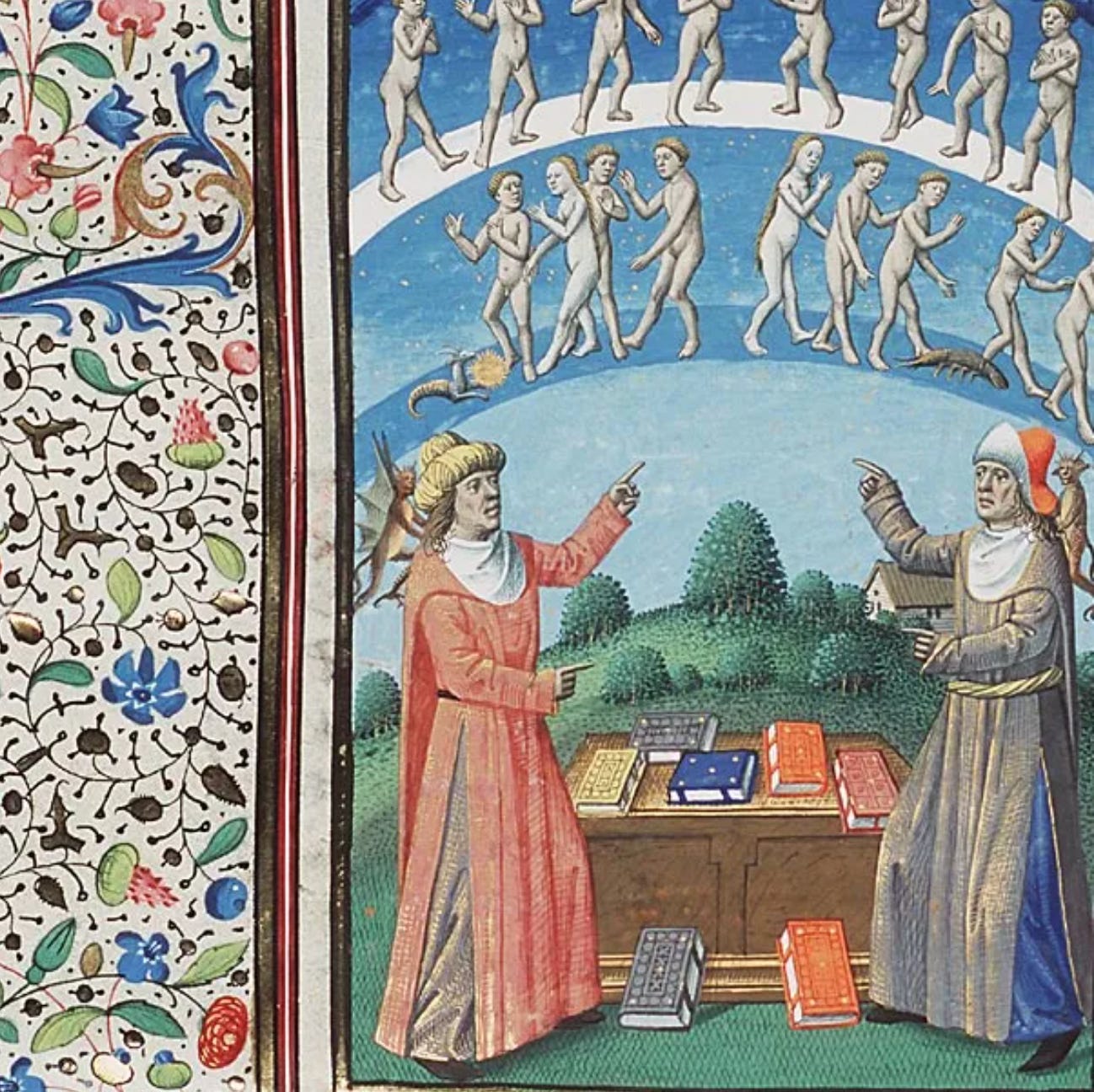
Notably, Caldecott highlights that Boehmean language expresses this theistic emanationism with the term ‘Magic’. The physicist’s world of atomic and sub-atomic particle formations is not the corporeal world of our experience. It is at best a mere mathematical analysis of prime-matter-in-becoming in its reception of substantial forms—forms that themselves must be accounted for somehow, namely as created essences that reflect the ideas in the divine mind. And when it becomes apparent that the world of the physicist only makes sense within an emanationist ontology like that of many classical and Patristic thinkers, you then at once realise that the cosmos with which we’re surrounded and of which we are a part, is not a massive jumble of lumps of stuff, but a magical order ever being sung into being by the Eternal Present.
Magic, in this sense, has two meanings. In Boehme’s idiom, Magic is the name for the underlying reality of the natural phenomena we encounter through our senses, the foundation of the corporeal world. But Magic is also analogised to mean the affective response to God’s outpouring of Himself in His creative act. Magic, then, is both divine emanation and creaturely participation. Magic is the gods speaking God back to God. What ancient Christianity claimed, and what was so repugnant to the iconoclastic Puritans who railed against the old folk traditions of deep England, was that the Incarnation’s ultimate effect was that all who shared in its power became themselves gods upon the earth, who thus confidently spoke God back to God.
The God of Deep Wessex
Whatever the origins of the Filly Loo—whether pagan or Christian, or a synthesis of both—there is a reason why the old Christianity of these Isles conserved this festival and fostered it down the centuries until a new Christianity in the 17th century sought to abolish it. The reason being that this new form of Christianity wasn’t Christianity at all, but a fanatical materialism that tried to maintain a sentimental attachment to a romanticised ‘Biblical Jesus’ whilst conceding all cosmological ground to the re-emerging Democritean atomism of that century, promulgated by John Locke here and Rene Descartes abroad. And these new sentimental materialists, whose heirs have since dominated the world and established what is roundly termed ‘modernity’, were content to kill anyone and destroy anything that conserved the Magic of the sacramental cosmos.
A bunch of children chasing a Green Man around a Dorsetshire village while a group of farmers swig locally brewed ale to the backdrop of competing Morris dancers may sound like a lot of frivolity, but there’s actually something very profound going on. Such a scene is a total affront to the modern world and all on which it is contingent. Such festivity is not instrumental, it’s not productive, it’s not ideological, it’s not corrupting. In short, it’s not modern. It is pure Magic.
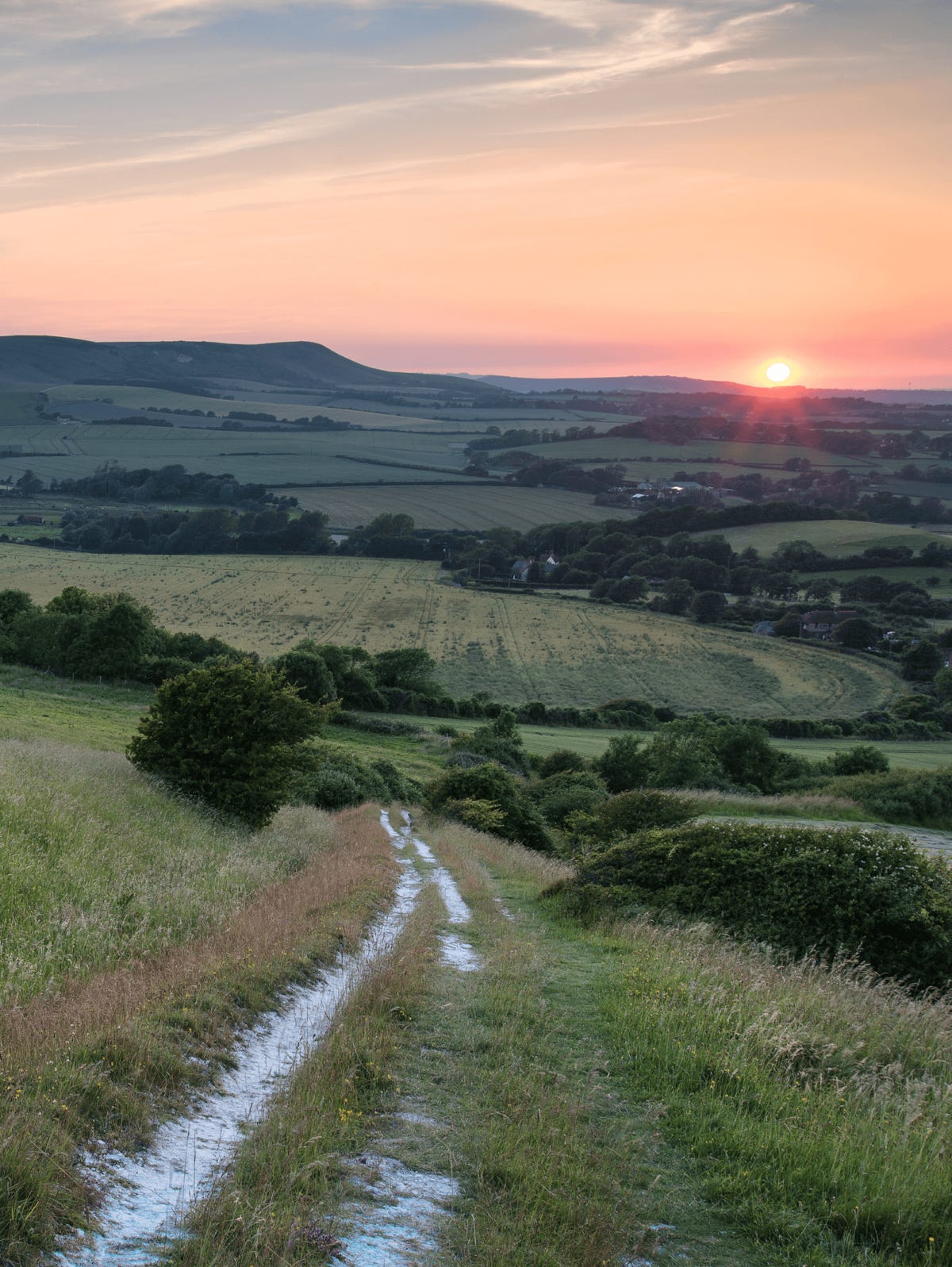
When the Horn Dancers arrive, crowned with the antlers of great fallow harts that once roamed the nearby Cranborne Chase, an ancient royal hunting ground whereon these bucks roared and collided amid the Autumn rut, those dancers liturgise the great natural drama of the landscape that has flowed forth from the Ground of Being. Hence, they offer that drama back to the realm of meaning in an act of speaking God to God. Whether any of the participants in the Filly Loo understand the deeper meaning of what transpires therein is irrelevant. Most of what we do throughout life is done intuitively rather than understandingly, which is how it ought to be. Even when we pray, we simply render explicit what is already always the case, namely that we are because we are willed, and merely by being we are already in a love affair with the One who willed that we be.
As noted, the Filly Loo begins with the rousing of the Green Man, the English embodiment of what Hildegard of Bingen called the ‘divine viridity’, and we might say that the evening ends with a return of all visitors to the landscape where they might spot the Green Man waiting for them among the trees, or in the streams and rivers, or along the coast, or in the fields, or wandering on the footpaths. Among the regions of England, deep Wessex is perhaps where the natural and the supernatural remain most chaotically and yet intricately entwined, for the redemption of the former and the greening of the latter.
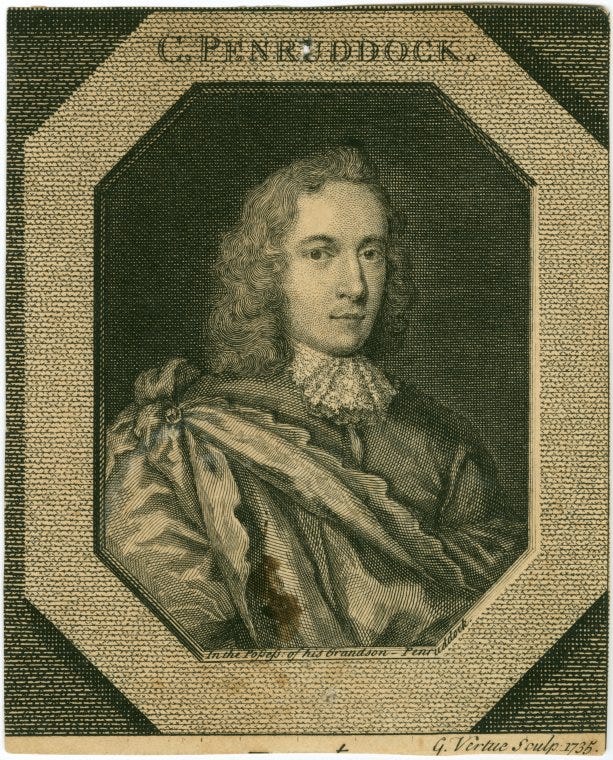
It shouldn’t therefore surprise us that Oliver Cromwell’s regime was especially harsh in that part of England, forced as it was to endure a concentrated military occupation and a terrible crackdown following the 1655 Penruddock Uprising against his tyranny. From Salisbury westward, England was heavily royalist and hence was a constant target for harassment by the New Model Army. And it wouldn’t surprise me if that noble Moonraker John Penruddock wanted to see the restoration of the Stuart monarchy as much as he did that of the Filly Loo. Cromwell was, in essence, a genuinely modern man, and there was and is just so much about Wessex that is very unmodern. Wessex feels unmodern because it remains Magical, and never is that more obvious than when reeling with the Green Man at the Filly Loo.
Lovely! How I wish I could have been there, but reading this, I almost was.
Really fascinating thank you.